Finance, stress or couple in house with paper, payment pressure or bankruptcy in money management. Worry, tax review or people in home with laptop, missing bill or loss in poor financial planning

Why Regulated Utilities Lose More on Uneconomic Power Plants
Business models, not technological constraints, determine whether utilities run money-losing power plants. We offer three solutions for regulators to fix that.
Across US power markets, a clear pattern is emerging: utilities that can pass fuel costs on to customers through rate regulation tend to operate coal and gas plants even when they lose money. Merchant power plant owners — companies that sell electricity into wholesale markets and don’t have captive customers to cover market losses — don’t do that nearly as often.
Plants are uneconomic when they continue to operate even when lower-cost resources are available, which results in gross losses for the plant and unnecessarily high energy bills for customers. This has resulted in $23 billion in gross losses from uneconomic coal plant operations since 2015.
New RMI analysis shows that rate-regulated utilities consistently produce disproportionately larger gross losses than merchant owners, even after accounting for differences in how much capacity each group owns. This pattern holds true across both coal- and gas-fired power plants.
The differences seen between rate-regulated and merchant plants are not a result of differences in fuel type or plant flexibility. It is a problem of incentives and the regulatory context in which each plant operates.
By their design, wholesale markets provide a clear signal for when operating a plant would be insufficient for covering their operating costs. In competitive markets, those signals drive behavior such as reduced output, decommitment of units, or decisions to retire plants entirely. Existing rate-regulation frameworks can mute those signals.
Where utilities are able to recover fuel and operating costs from captive customers, we see higher rates of continued operation of units, even when continuing to run the plant no longer makes financial sense. This dynamic transfers risk from shareholders to ratepayers, leading customers to pay for plants the market has already deemed uneconomic.
The “moral hazard” of fuel cost recovery
We measure “gross losses” by asking a simple question: does a power plant earn enough revenue in wholesale markets to cover its basic operating costs? When revenues fall short of variable operating costs, the plant loses money each time it runs. Short-term losses can occur during market volatility, but persistent gross losses over time suggest that there is a structural problem that is not explained by normal market volatility.
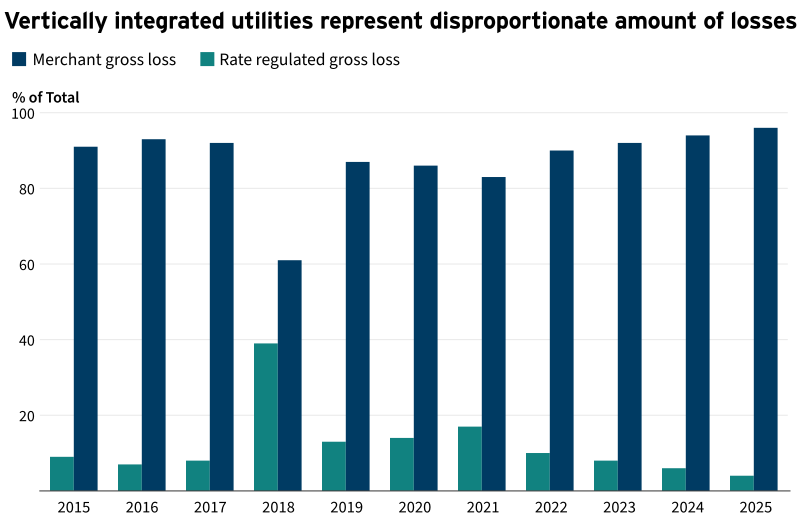
Across nearly every year we reviewed from 2015–2025, coal plants owned by rate-regulated utilities lost more money per megawatt (MW) than coal plants owned by merchant generators.
 Source: RMI Analysis
Rate-regulated utilities own roughly 78% of US coal capacity, yet account for 96% of total gross losses from uneconomic coal operations. Merchant coal plants, on the other hand, represent about 22% of coal capacity but only around 4% of gross losses. This disparity is not explained by technology alone. There is no evidence to suggest that merchant-owned coal plants are newer or more flexible. The defining difference is exposure to market risk and the opportunity (or not) to recover expenditures from ratepayers.
Under traditional cost-of-service regulation and policies such as fuel adjustment clauses, through which fuel costs are passed through to customers, many operating costs for rate-regulated utilities can be recovered directly from ratepayers. This means that the financial consequences of operating plants when it is not economic to do so are borne by ratepayers, creating a situation that economists refer to as a “moral hazard,” when one party makes the decisions while another bears the risk of those decisions. This dynamic weakens the incentive to respond to market price signals by reducing output, optimizing dispatch, or retiring persistently uneconomic plants.
Self-commitment practices also amplify this dynamic. Instead of allowing units to compete economically in day-ahead and real-time markets, utilities often self-commit coal units in day-ahead markets based on internal assumptions rather than relying strictly on market price signals (self-commitment is the term used in some RTOs while others use different terms to describe this same practice). In some cases, these internal models may assume higher avoided costs or operational constraints that are not reflected in prevailing market prices.
As a result, plants are committed even when forecasted market revenues are insufficient to cover marginal costs. Merchant operators, on the other hand, facing immediate financial exposure, directly bear the consequences of similar decisions.
The pattern is repeated across coal and gas
A common response that attempts to explain uneconomic coal plant operations is that coal plants are inherently inflexible and are therefore unable to respond to market signals. Coal is less flexible than many other resources. But that fact does not fully explain the data.
First, merchant coal plants are not inherently more flexible than coal plants owned by rate-regulated utilities, yet merchant coal plants incur far fewer gross losses. If the inflexibility of coal plants alone was the primary factor that led to uneconomic operations, we would expect to see gross losses more evenly distributed across ownership types.
Second, we see similar patterns across rate-regulated and merchant owners of gas plants, which are much more flexible than coal plants. When gas plants generate gross losses, those losses are also disproportionately concentrated among rate-regulated utilities.
Gas plants owned by merchant generators tend to scale back operations when market revenues fail to cover variable costs. Rate-regulated utilities continue operating uneconomic gas units more frequently, resulting in higher gross losses per megawatt of capacity. Steam turbine gas plants show a particularly stark disparity between gross losses relative to the share of ownership across merchant and rate-regulated owners: while merchant owners operate 41% of the steam turbine fleet, they generate only 16% of the gross losses. The pattern across coal and gas makes clear that this is not a fuel problem. It is an incentive problem.
Regulatory solutions: Realigning incentives with least-cost outcomes
Persistent gross losses from coal and gas plants point to a regulatory problem, not a problem of fuel or technology type. The good news is that regulators and market operators have tools to address this misalignment.
- Greater scrutiny in fuel dockets
State regulators play a central role in reviewing fuel cost recovery and have the authority to disallow costs that are uneconomic. Given the stark differences in gross losses between merchant and rate-regulated owners, commissions should closely scrutinize self-commitment practices and require stronger justification when utilities operate units that consistently lose money in wholesale markets. Regulators can tighten standards for fuel cost recovery when dispatch decisions deviate from economic outcomes and disallow recovery when it is clear running the coal plants was imprudent. Greater transparency and oversight can reduce unnecessary customer costs.
- Allow economic decommitment in organized markets
Market rules also matter, and regional transmission organizations (RTOs) have an important role to play in supporting economic dispatch. In 2024, for example, the Midcontinent ISO (MISO) Independent Market Monitor recommended allowing resources scheduled in the day-ahead market to decommit when it would be more economic to do so rather than generate electricity. Enabling decommitment of uneconomic units strengthens market discipline and reduces avoidable losses.
- Mandatory economic dispatch in emerging markets
In emerging wholesale markets in the West and Southeast, ensuring mandatory economic dispatch can prevent the entrenchment of uneconomic self-commitment practices. As new market structures develop, rules to establish centralized de-commitment for prolonged uneconomic operations can help to embed economic discipline at the outset, reducing long-term customer risk. In addition, stricter reporting requirements, such as data on revenues, costs, and self-commitment practices, can further illuminate uneconomic dispatch trends and help regulators and stakeholders identify solutions to reduce customer costs.
It’s about incentives
Gross losses from coal and gas plants are not evenly distributed across the power sector. They are concentrated among rate-regulated utilities with captive customers. This pattern is consistent across fuels and technologies. It is not primarily about flexibility, fuel type, or short-term market conditions. It is about incentives.
Aligning regulatory incentives with market signals can lower costs, reduce unnecessary customer exposure to risk, and ensure that utilities operate assets in line with least-cost principles. Without reform, customers will continue overpaying for energy when more economic resources are available.