Stopping Global Gas Loss in Its Tracks
How companies can bolster energy, economic, and climate security.
Energy and economic security can be rapidly reinforced by stopping gas loss. The amount of methane vented and leaked into the air today by the global oil and gas industry is even greater than the total pre-war volume of gas passing through the Strait of Hormuz. When flared gas is added, this overall energy waste is equal to over one-half of worldwide LNG exports.
With energy markets roiling over the loss of 20% of the gas volume traveling through this chokepoint, companies have a responsibility to stop their gas loss on energy security grounds alone. Moreover, given price hikes due to the ongoing conflict, there are immediate economic benefits for selling rather than wasting their gas.
Texas’s oil and gas industry spotlights this massive energy and economic opportunity. Preventing gas venting and flaring in Texas alone could make up the total lost gas volume due to current disruptions in the Persian Gulf. Preventing gas waste and accurately accounting for companies’ self-reported gas loss is not only fair practice, but it also has paybacks for industry and increases resource royalties to the Texas state budget. By keeping gas in the pipe and out of the air, operators can also safeguard people and the planet. As one of the world’s biggest oil and gas producers, Texas serves as a case study to investigate and quantify how companies can step up to bolster energy, economic, and climate security by stopping gas loss.
Reducing system inefficiencies bolsters energy security
There are inefficiencies in oil and gas industry operations that lead to gas waste and methane emissions. The industry acknowledges it. Mitigating product loss, which is paramount when energy supplies are constrained, can be prevented by tighter oversight, better operations, and strategic investments.
Gas loss is becoming increasingly visible due to advances in satellites, sensors, and continuous monitoring. Ongoing measurements are creating alignment around a new priority: turning actionable data into operational decisions that improve reliability, reduce costs, offer payback, and increase production efficiency. The barrier is no longer technology, but workflows — ensuring that actionable insights reach engineers and operators in time to drive change.
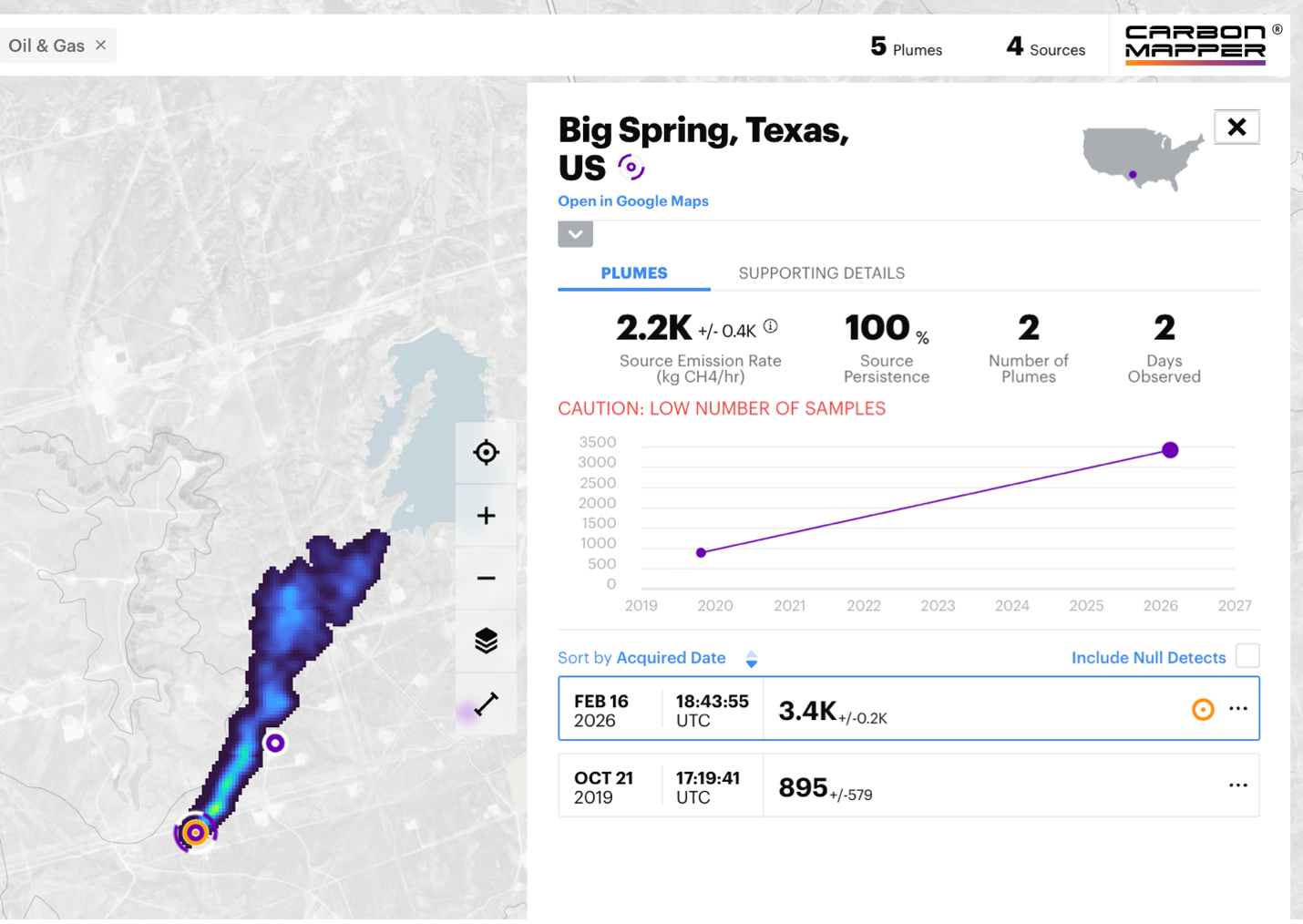
Over 10,000 plumes have been spotted in Texas alone over the past several years, amounting to some hundreds of tons of wasted methane gas. A recent gas release spewing over three tons of methane was detected on the eastern edge of the Permian Basin in Texas, as shown below. The two leaks detected by Carbon Mapper at this site, which persisted for two days, wasted as much energy as it takes to dry over 300,000 loads of laundry.
Sample methane plume spotted in Texas by satellites
Lowering the volume of gas we waste heightens energy security because more gas makes it to market. Conversely, supply shocks trigger fuel shortages, especially in import-dependent nations. And energy insecurity drives up the price of oil and gas, leading to inflation and economic insecurity.
Preventing gas waste produces revenue streams and boosts economic security
Methane is the main component in gas, and is also co-produced with oil. When it’s allowed to escape into the atmosphere, it’s sheer energy and material waste. When kept in the pipe and sold, it’s a valuable commodity. Moreover, when companies minimize their operational inefficiencies, the gains are transformed into economic benefits for communities in the form of increased revenues, royalties, and jobs.
The industry knows its gas value proposition. When prices are high, gas loss drops. It then rises when prices are low, as plotted for the United States below.
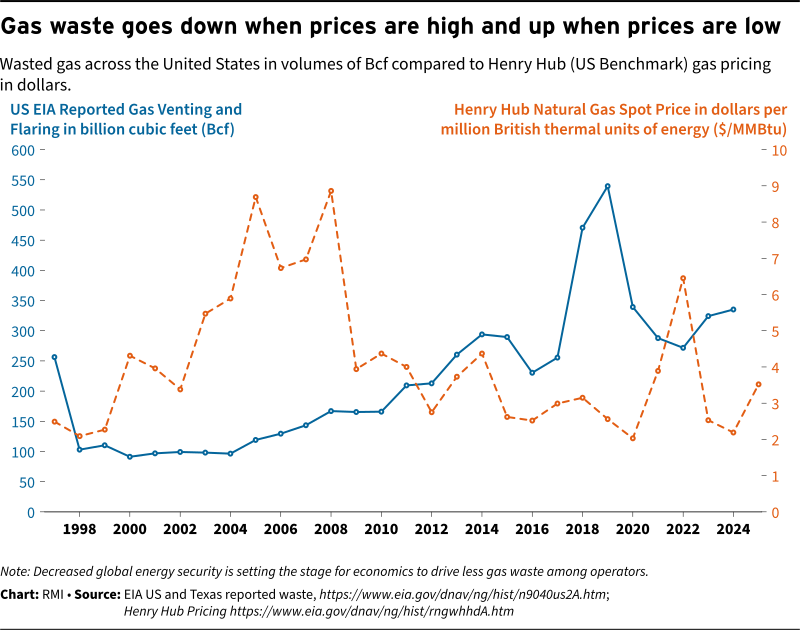
On a global scale, the estimated 81 million metric tons of methane that the oil and gas industry squanders annually through venting and leaking its gas has an estimated economic value today of $20 billion to 50 billion a year, depending on highly variable gas prices. (See endnote for assumptions). In terms of overall financial opportunities, the economic loss of wasted gas is twice as great when also accounting for the additional 150 billion cubic meters (bcm) of gas that is flared worldwide. Given the high volatility of global gas prices, foregone revenue streams, royalties, and resource rents from wasted gas are a material corporate and national concern.
Stopping methane emissions rapidly improves climate security
Methane is over 80 times more powerful at heating Earth over its decade-long lifetime. In other words, every metric ton of methane that is stopped or avoided dramatically lowers damages wrought by droughts, flash floods, excess heat, firestorms, and other climate-driven disasters. The fastest path to reducing methane emissions is improving oil and gas industry operations to prevent gas loss. The companies that succeed in this quest are those that can keep their gas in the pipe.
Improved measurement, models, and methodologies are enabling the shift from data insights to durable action. For example, Carbon Mapper’s data portal identifies large point source methane-emitting events. This focuses operators’ attention on rapidly fixing their super-emitting assets. Separately, NASA’s Black Marble product analyzes nightlights using the VIIRS satellite to make gas flaring data publicly available. And ClimateTRACE quantifies wide-ranging oil and gas industry methane emissions between countries.
Drilling down in Texas
RMI’s study, Drilling Down on Gas Loss, finds that Texas oil and gas operators’ self-reported gas loss is likely 3–4.5 times higher than what is currently self-reported. This results in energy waste and methane emissions that are highly variable across basins, well types, and production volumes, as mapped below.
For example, in February 2026, Carbon Mapper detected a plume in Big Spring, Texas (illustrated above) that emitted 3.4 tons of methane per hour. Coincidentally, this major gas release is in Howard County, Texas, the same county that RMI’s study identified as highly wasteful. Together, bottom-up and top-down analyses can provide real-world validation of gas loss.
Across Texas, the volume of wasted gas identified in this state alone could yield some 15.6 bcm per year of marketable gas. In 2024, before gas prices recently spiked, over $1 billion in Texas’s gas value was forgone, with associated lost tax revenue of nearly $100 million. Today, this amounts to $1.6 billion in forgone gas value at current Henry Hub gas prices.
Over half of the gas wasted in Texas is attributed to low-volume oil wells that intentionally vent their gas (predominantly methane) directly into the air. This loss is under operators’ control. Moreover, this intentional waste is frequently disguised through under- or false reporting. Nearly one-half of Texas’s company-operated oil leases reported zero gas produced or zero gas loss during at least one month in 2024. Gas leases more accurately reported their product loss.
Why industry needs to accurately report and stop gas loss
The sizeable gas loss in Texas alone masks the scale of energy waste from an industry that is largely promoting waste reduction. For example, at CERAWeek 2026 — the largest energy convening in Houston, Texas — numerous companies made clear that the oil and gas industry is ready to treat methane and wasted gas not just as an environmental liability, but as signals of operational inefficiency and lost economic value.
Some operators note that spikes in flaring during production is too common, reinforcing the need for actionable, real-time data to improve operations. Other operators emphasize that methane mitigation is becoming embedded in operational excellence, with reductions made through equipment upgrades. Across international and national oil and gas companies, the message was consistent: better data leads to better operations — reducing downtime, improving process control, and modernizing equipment — which directly translates into lower emissions and economic gains.
When companies reduce gas waste, they not only make a difference to their bottom lines. The war in the Middle East highlights a devastating reminder that preventing gas loss is also a matter of energy security. All told, some 112 billion cubic meters of gas passes through the Strait of Hormuz annually. Remarkably, this disrupted trade volume that is upending global energy markets is just a fraction of the 280 billion cubic meters of gas that oil and gas companies discard through venting and flaring every year. We have the policy and market tools to prevent gas loss. If acted on, this will win-win-win, significantly bolstering energy, economic, and environmental security.
Acknowledgment: Thank you to Dwayne Purvis (Purvis Energy Advisors) for his lead on the Texas study, Drilling Down on Gas Loss.
Endnotes: These calculations assume (1) a methane content in gas of 74%–85%; (2) methane density of 0.657 kilograms per cubic meter; (3) a heat conversion of 1038 btu per cubic foot; (4) resource pricing of $3.70 per million British Thermal Units (MMbtu) for pipelined natural gas anchored on Henry Hub; (5) $11.33 per 1000 cubic feet for LNG; (6) 2024 Waha Gas Hub and Henry Hub prices of $0.21 to 2.21/MMbtu, respectively; (7) April’s Henry Hub gas spot price is computed as $2.79 per MMbtu for 2026.