Workers pour, level fresh concrete for sidewalk amidst construction activities on works day

Unlocking Low-Carbon Cement and Concrete Through Book and Claim
Used to speed decarbonization in aviation and shipping, book and claim could jumpstart cement and concrete decarbonization.
Cement and concrete are the most widely used human-made materials on Earth, with their consumption closely tied to economic growth and urbanization, and their climate impact responsible for approximately 8% of global carbon dioxide emissions. The sector is often described as hard to abate due to high thermal energy requirements (achieving sustained, high-temperature heat that is difficult to electrify at scale today), process emissions from clinker production (where the calcination of limestone releases CO₂), and the scale and longevity of existing assets (as capital-intensive kilns are designed to operate for decades, slowing the turnover to lower-emissions technologies). With new technologies emerging, the challenge is no longer invention—it is deployment of existing solutions at speed and scale.
That transition to net-zero emissions is no easy feat. Low-carbon cement and concrete production frequently requires substantial upfront capital investment—ranging from hundreds of millions to over a billion dollars—which in turn often results in higher-cost products, particularly in the early stages of deployment before they can be scaled. As a result, producers require a high degree of long-term revenue certainty to justify investment, particularly when selling into commodity markets where price premiums for low-carbon materials remain uncertain. Absent predictable demand and sustained price signals, these investments are unlikely to materialize at the scale required to keep pace with global climate targets.
Despite growing voluntary demand for low-carbon concrete, alongside emerging regulatory requirements, several structural challenges continue to limit the deployment of low-carbon cement and concrete at scale.
- Supply chains are highly localized, with production and consumption typically occurring within the same geographic region, which constrains developers’ ability to access low-carbon products near project sites even where they exist elsewhere.
- Procurement practices are largely project-based and short-term, with cement and concrete typically purchased on a spot basis tied to individual construction projects, making it difficult to establish the long-term offtake agreements needed to underwrite capital-intensive investments.
- The value chain is fragmented, with geographic separation between the entities that control emissions (producers) and those with the willingness or mandate to pay for reductions (end users, developers, corporate buyers), limiting buyers’ ability to physically procure low-carbon concrete and hindering the ability to translate demand into bankable revenue streams for producers.
Book and Claim: Decoupling Supply and Demand to Enable Scale
Practical solutions exist to overcome the challenges associated with deploying low-carbon technologies, with one of the most promising being alternative chain-of-custody models such as book and claim. A book and claim system connects buyers willing to pay a premium for verified low-carbon attributes with producers, even when physical delivery of the low-carbon product is not possible or would be operationally complex. Under this model, the buyer does not receive the physical low-carbon cement or concrete but instead purchases an environmental attribute certificate (EAC) representing the emissions intensity associated with the product. The buying company can then apply the emissions benefit to its carbon inventory. Meanwhile, the producer sells the physical product into the local market at conventional emissions intensity and at the normal market rate.
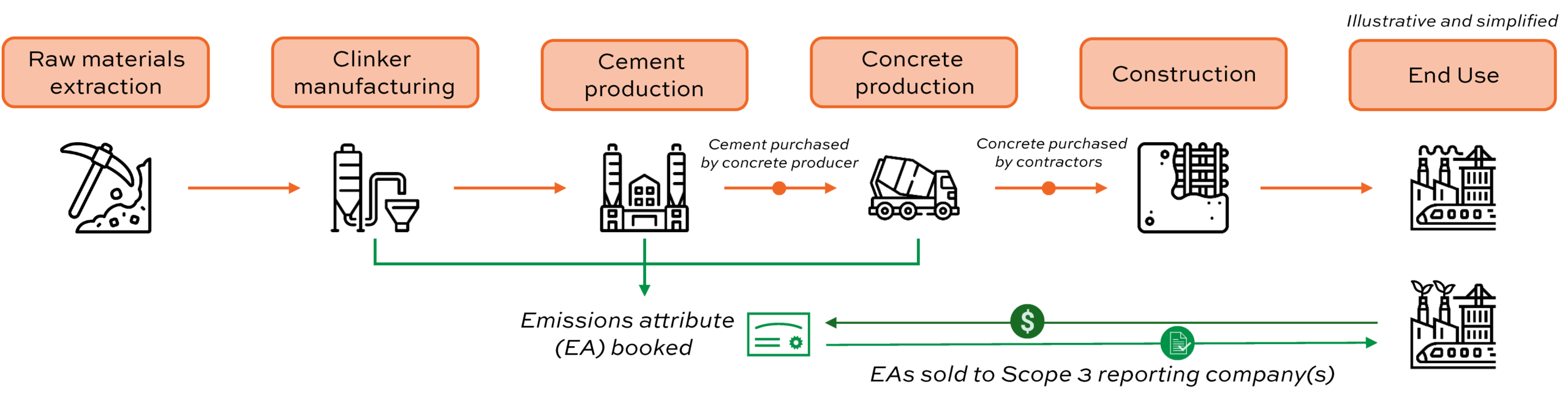
Book and claim systems have already been successfully applied in other sectors (e.g., renewable energy certificates and sustainable aviation fuel certificates [SAFc]), where they have helped catalyze demand and unlock investment in low-carbon alternatives. For example, across seven SAF certificate registries, approximately 500,000 tons of neat SAF certificates have been issued, equivalent to 150,000,000 tons of carbon dioxide equivalent avoided compared to traditional jet fuel. Central to the success of these markets are rigorous safeguards that ensure environmental integrity, transparency, and credibility.
Designing a High-Integrity Book and Claim System
Recognizing the need for a book and claim system for the cement and concrete sector, RMI and the Center for Green Market Activation (GMA) convened more than 30 leaders across the value chain and collaborated for over a year to develop a framework for applying book and claim in this industry. This framework was formally approved by the group’s steering committee in March 2026, paving the way for its publication and public release to support adoption of a high-integrity system in the sector. The following sections provide an overview of the framework, highlighting several key design decisions.
Early in the process, the group aligned on six guiding principles to ensure the system would be both high-integrity and practical to use. The goal was to design a framework that is:
- Credible: Credible from an environmental standpoint, driving high-integrity atmospheric benefits
- Usable: Straightforward and usable to facilitate scalable market transactions for low-carbon cement and/or concrete attributes
- Compatible: Compatible with existing regulatory and non-regulatory frameworks and best practices
- Comprehensive: Comprehensive across a range of decarbonization solutions to support multiple viable pathways
- Unifying: Able to serve diverse geographic regions and markets, minimizing fragmentation and promoting geographic equity
- Adaptable: Designed for longevity and adaptability for future low-carbon technologies
These principles shaped several critical design decisions, including the choice of functional units, emissions eligibility thresholds, and claims permitted for both EAC purchasers and physical product recipients.
Functional Units
In a book and claim system, the functional unit defines the basis of the transaction: this could be tons of clinker, tons of cement, or a specified volume of concrete. The choice involves tradeoffs between comprehensiveness and practicality. More upstream units (e.g., clinker or cement) are simpler to standardize and transact, while downstream units (e.g., concrete) capture a broader range of emissions reduction opportunities but introduce additional complexity. Importantly, there is no single pathway to decarbonizing cement and concrete– achieving net zero will require a range of solutions at various stages in the value chain.
To balance these considerations, the framework includes three functional units: clinker, cement, and concrete. This inclusive approach enables participation across a broad range of decarbonization strategies—from carbon capture and storage to alternative binders to supplementary cementitious materials (SCMs) and optimized concrete formulations—maximizing the system’s ability to accelerate scale.
Emissions Thresholds and Eligibility
While functional units determine who can participate, eligibility thresholds determine what qualifies as “low carbon.” The framework aims to support a broad suite of decarbonization technologies while ensuring that book and claim is reserved for solutions delivering meaningful emissions reductions.
To define eligibility, the framework leverages the Global Cement and Concrete Association’s (GCCA) Low-Carbon Rating for Cement and Concrete, which builds on environmental product declarations (EPDs) to benchmark emissions intensity.
Under the framework:
- Products must achieve a GCCA Low-Carbon Rating of “C” before 2030 (approximately a 40% emissions reduction from American Cement Association OPC benchmark), and
- A rating of “B” after 2030 (approximately a 50% emissions reduction from ACA’s OPC benchmark).
This graduated threshold allows emerging solutions to scale while steadily raising ambition over time.
Claims and Accounting
Several emerging standards, including the Science Based Targets initiative (SBTi), the Greenhouse Gas Protocol, and the Advanced and Indirect Mitigation Platform, will inform how environmental attribute certificates are reported and applied within emissions inventories. The framework builds on these efforts to provide sector-specific guidance, including accounting rules, baseline determination, matching requirements, and safeguards to prevent double counting.
An important component of ensuring environmental integrity for book and claim systems is the avoidance of erroneous double counting, when two organizations at the same layer of the value chain make the same claim. The purchaser of the EAC is claiming the right to the low-carbon emissions intensity, but the physical buyer is taking on potential reputational risk and new operational requirements by deploying the novel product. Physical recipients may not claim any inventory reductions reflecting the low carbon intensity of the product, because that is already claimed by the EAC purchaser, but stakeholders may negotiate to enable the physical recipients to make limited qualitative claims, for example, about using innovative materials or partnering with a low-carbon supplier, provided these claims do not imply ownership of the emissions reductions or characterize the product as low-carbon.
Looking Ahead: Scaling Demand Through Aggregation
Book and claim is a critical bridge to capital flow, unlocking investments in emerging low-carbon technologies. For the first time, developers will not be limited by the physical availability of low-carbon concrete at the site of their project, and suppliers will have demand signals and financing for decarbonization projects. With sufficient and coordinated demand, book and claim can play a central role in scaling low-carbon cement and concrete.
Notably, bilateral deals are beginning to take place for low-carbon cement or concrete attributes. While these deals represent interest in low-carbon commodities and a willingness to pay for them, demand must significantly increase to generate enough offtake for low-emissions production technologies to be deployed at scale. Demand aggregation mechanisms such as the Sustainable Cement and Concrete Buyers Alliance (SCoBA) play a vital role in consolidating buyer interest, signaling long-term demand, and providing producers with the volume and confidence needed to invest in first-of-a-kind and early-scale projects.
Companies that develop, finance, or own physical infrastructure have a key role to play and must actively engage with the emissions associated with the materials they procure. By participating in book and claim systems and demand aggregation initiatives, these actors can help unlock the investment needed to scale low-carbon solutions. RMI and GMA encourage organizations to review this framework to understand how EACs and buyer alliances such as SCoBA can support their decarbonization strategies.
Together, high-integrity book and claim systems and coordinated demand aggregation can accelerate commercialization, helping transform one of the world’s most essential industries into a cornerstone of a net-zero economy.
For more information or to explore opportunities for engagement, please contact info@buildscoba.org.