Redefining Rooftop Solar Through Community Action
In the Dominican Republic, a new approach to rooftop solar is allowing communities to bring clean energy to households long priced out of the energy transition.
Households across the Dominican Republic (DR) face electricity outages, rising electricity bills, and a system that depends on fuel shipped from thousands of miles away. Electricity is essential to daily life, yet for many DR households, its cost and reliability remain a constant concern. Just last month, the island had a nationwide blackout, the second in three months, following a failure in its national power grid.
The DR is home to nearly 12 million people, making it one of the largest electricity markets in the Caribbean, with three primary utility companies serving more than 3.2 million homes and businesses. To meet this energy demand, the country operates one of the largest power generation fleets in the region, dominated by centralized coal, oil, and natural gas plants, which account for nearly 83% of electricity generation. Like many islands around the world, the DR has no domestic coal, oil, or gas reserves and must import all its fossil fuels. Importing fuel is expensive, as energy prices are determined thousands of miles away and subject to a turbulent global market. Additionally, relying on imported fuel reduces energy security, as shifts in global supply can disrupt availability, drive price volatility, and expose consumers and economies to greater risk.
This fossil fuel dependence comes at a high cost. The government spends roughly $2 billion annually on electricity subsidies to ensure power remains affordable for low- and middle-income (LMI) households. Subsidies of this scale place pressure on public finances and taxpayers and force utility companies to rely on government transfers to remain operational. While they provide short-term affordability, these subsidies lock the country into continued dependence on imported fossil fuels, discourage investment in alternative energy, and ultimately shift costs back to taxpayers and the public sector.
Fortunately, there is a better solution.
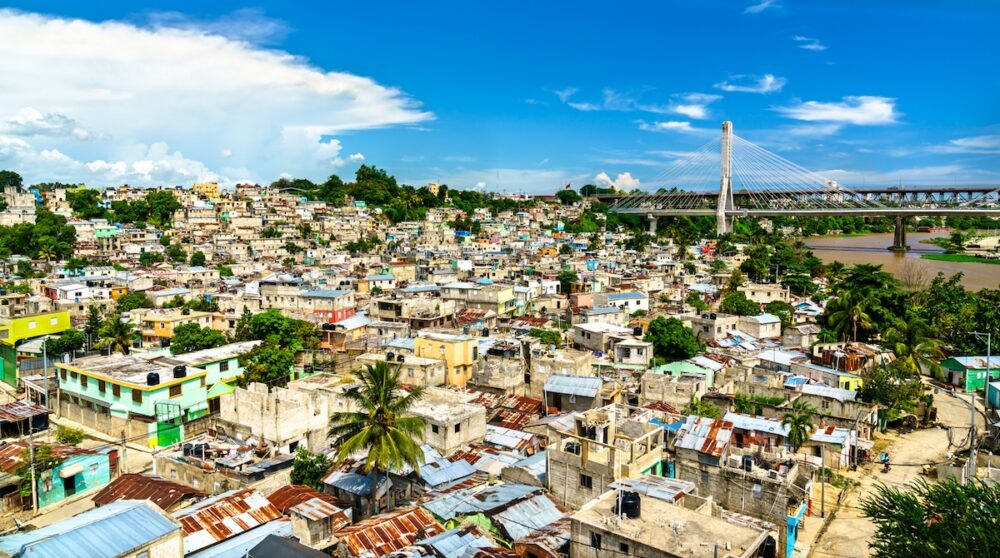
Sitting just north of the equator, the DR receives steady sunshine year-round. Although solar energy is already in use across the country, its full potential remains largely untapped. With dense neighborhoods, flat rooftops, and minimal shading, rooftop solar is no longer a distant possibility, but an immediate and scalable resource. Distributed solar could transform the built environment into a decentralized, domestic energy asset, shifting electricity generation from large power plants to the rooftops of homes and businesses.
An unequal energy transition
Currently, rooftop solar systems in the DR are primarily concentrated in wealthier households that can afford to purchase solar and battery storage systems outright. For this reason, a tiny share of high-income customers control nearly all rooftop solar capacity, with roughly 4.5% of the population accounting for nearly 97% of the installed rooftop solar capacity.
This has created an unequal energy transition. LMI households remain reliant on subsidized electricity generated from imported fuels, while higher-income households invest in their own distributed generation, lowering their electricity costs and reducing their reliance on the grid. Paradoxically, this pattern increases fiscal pressure on the country. As high-income customers reduce their grid purchases, utility revenues decline without a corresponding reduction in the government’s fixed subsidy obligations, which are primarily directed toward LMI households.
In effect, solar adoption among high-income households erodes utility revenue and increases costs for all other households:
- Affluent households consume the most electricity, pay the largest bills, and therefore contribute a disproportionate share of utility revenue. Utilities rely on these customers to cover fixed costs such as power plants, fuel contracts, and grid maintenance.
- When high-income households install solar, the generation offsets a significant portion of their grid consumption, reducing their electricity purchases and directly lowering utility revenue.
- However, grid infrastructure, fuel contracts, and operational expenses remain largely fixed even when a small segment of customers reduces grid consumption. Utilities therefore face a revenue shortfall.
- The government steps in to cover the gap. To keep electricity service running, the state increases subsidy transfers to utilities.
- Public spending rises, even as private bills fall. Wealthier households save money, while the remaining customer base absorbs more of the system’s costs, disproportionately affecting low- and middle-income households.
In contrast, when LMI households install solar, they reduce their energy bills, and government subsidy payments can decline immediately (by an estimated US$15 million for every 100 MW installed). This can free public resources for other national priorities.
The challenge, then, is how to make solar affordable and accessible to these LMI households. The answer lies in community-led solar.
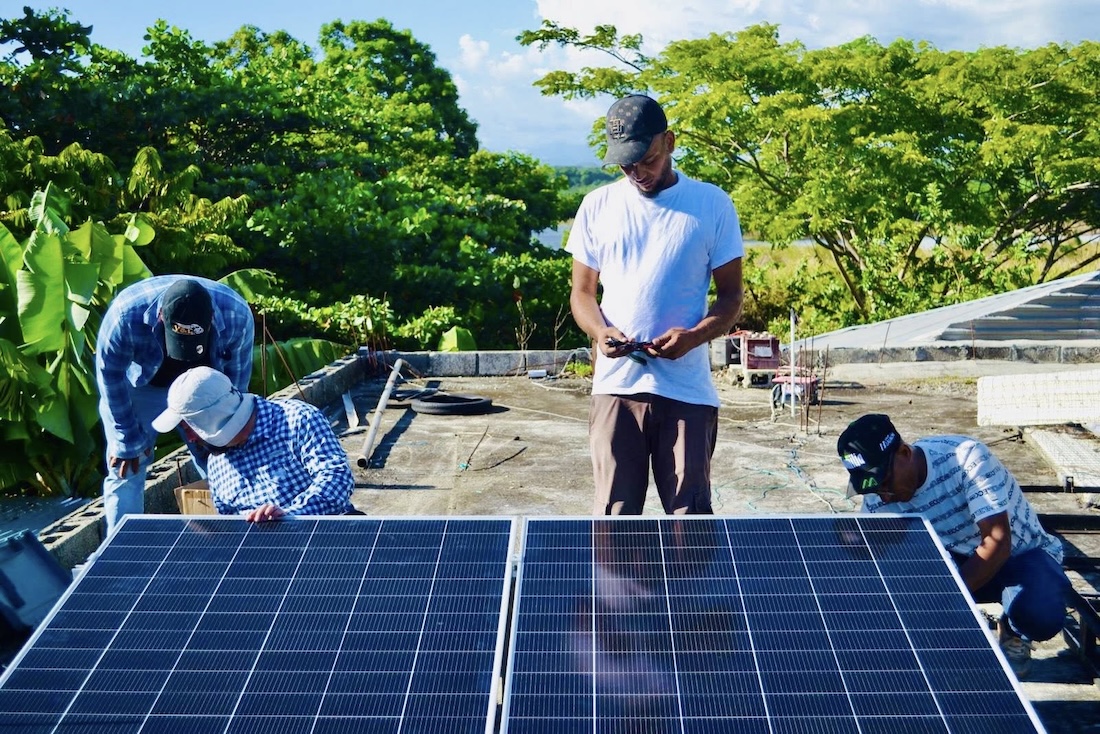
Convite Solar – A community-led solar approach
In response to the growing inequity around solar adoption and the consistent high subsidies locked around electricity, a group of civil-society organizations, cooperatives, municipalities, and international partners joined together to establish RD 100% Renovable: a coalition and platform committed to democratizing access to clean energy, strengthening policy frameworks, and ensuring that the benefits of renewable generation reach every community. The coalition set out to identify solutions that are socially equitable, financially viable, evidence-based, and deeply rooted in local communities. The result was Convite Solar.
In Dominican tradition, convite refers to a community gathering where neighbors work together to achieve a common goal. Convite Solar applies this cultural idea of communal support to installing and maintaining rooftop solar systems. At its core, the model reimagines rooftop solar as modular and standardized, designed for guided community installation rather than exclusive reliance on specialized contractors.
While solar is often perceived as highly technical and inaccessible, most residential systems consist of repeatable components that can be safely installed with proper training, clear instructional materials, and on-site supervision. Under this system, training, installation, and maintenance are a collective effort, with assistance from the local municipality, electricians, and coalition partners. Step-by-step guides, short training sessions, and supervised installations allow community members to actively participate in deploying and maintaining their own systems. By building local capacity, pooling labor, standardizing system design, and coordinating bulk procurement, the model lowers up-front equipment and installation costs while avoiding the need to restructure the existing subsidy framework. This generates local employment while promoting gender inclusion and building technical skills for those involved.
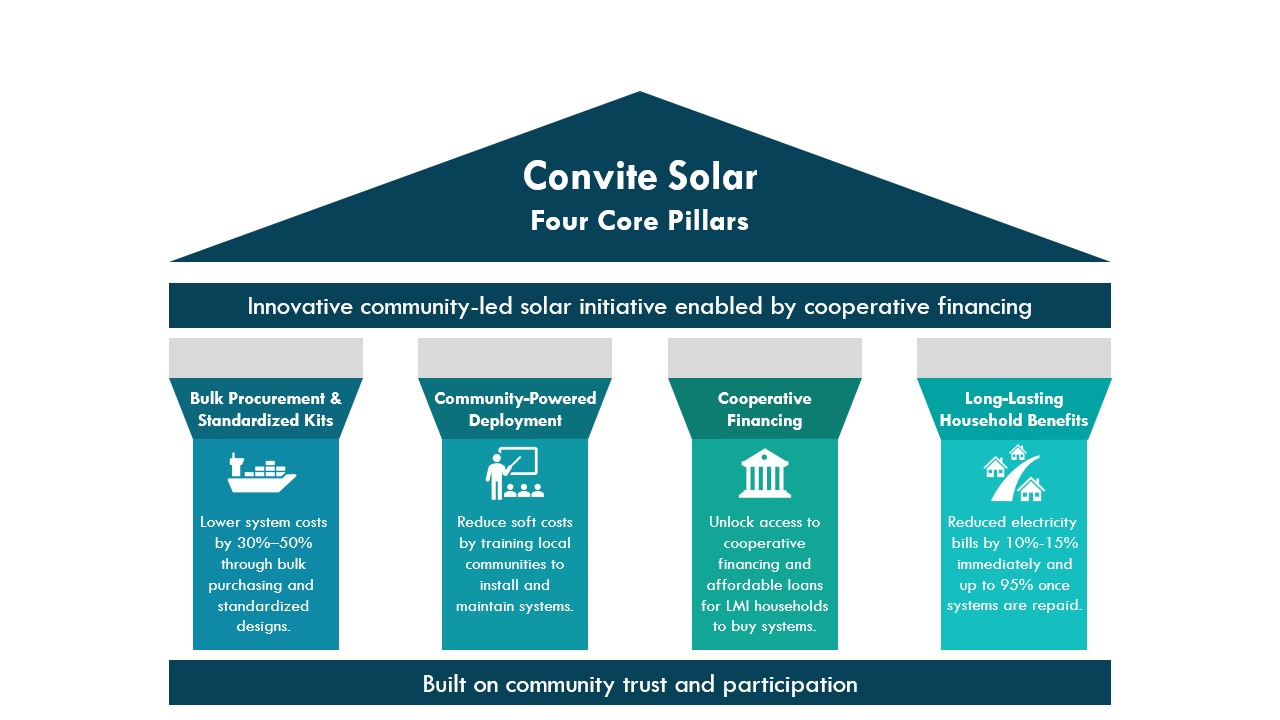
Convite Solar relies on four pillars:
The first Convite Solar pilot is underway in Nizao, a coastal city that has experienced both economic challenges and grid instability. To date, three solar-plus-battery systems have been installed to validate the technical design, test the cooperative loan mechanism (similar to a traditional bank loan with monthly payments to the cooperative), and assess community interest in the initiative. The systems include battery storage to enhance resilience during power outages and further reduce reliance on the national grid.
The early results have been highly encouraging. Community members gathered to support the installations, reinforcing the collaborative “convite” model. Participating households have demonstrated strong repayment capacity, and overall community response to the initiative has been overwhelmingly positive.
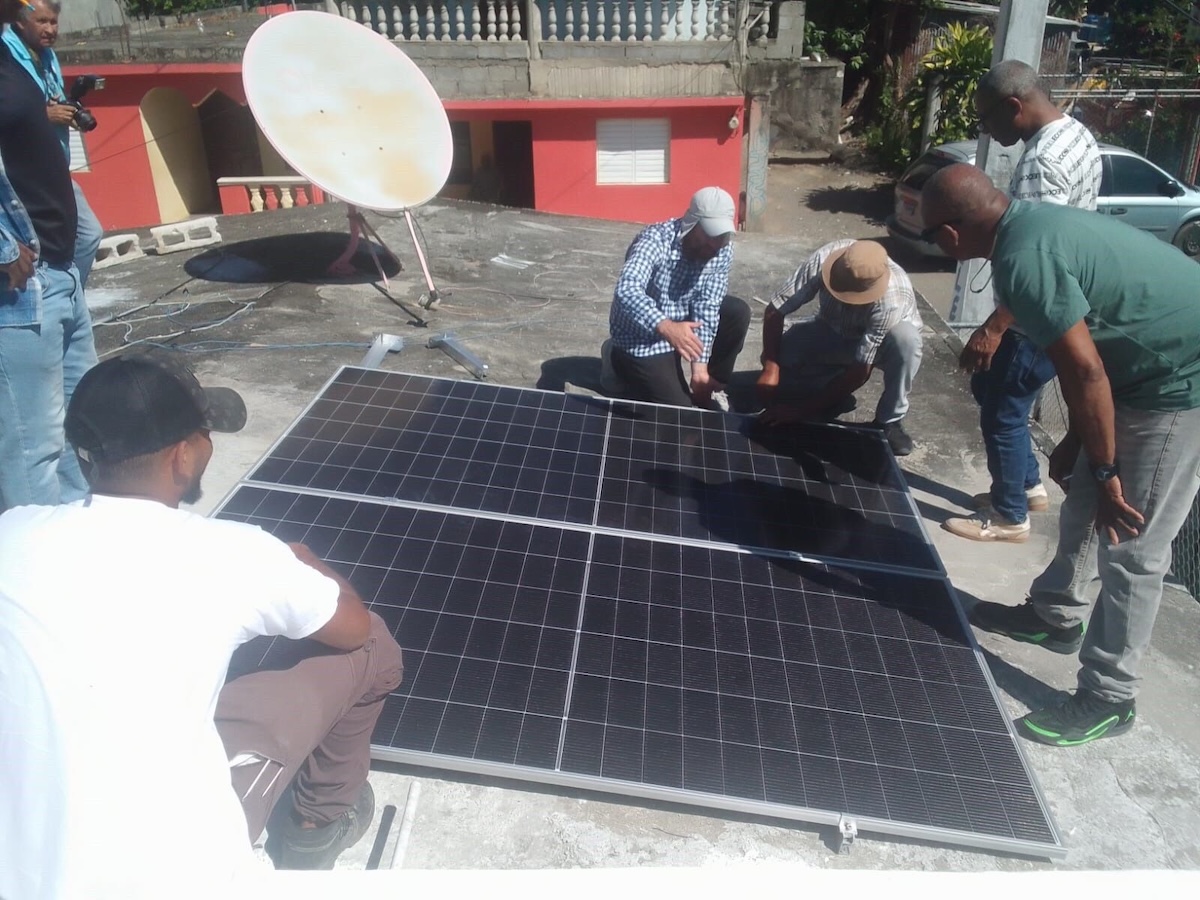 Community members in Nizao being trained on rooftop solar installation
"I am very surprised and happy because this month my electricity bill was RD$181.25 [US$2.99], when I usually pay more than RD$1,200 [US$19.77] per month. This means that the solar panels are supplying all the electricity I consume in my home. I'm only paying the minimum payment for having the Edesur [electric company] meter."
- Dionisio Moreta Rosario (César), Convite Solar participant with a four-panel system.
Based on this initial success, partner cooperatives have provided soft commitments to finance a larger pilot rollout. This next phase will include the first bulk procurement of standardized solar systems and will target 50 households, significantly reducing per-unit costs through coordinated purchasing.
When energy is produced locally, people understand it, trust it, and take ownership over it, much like locally grown food. Just like buying local food supports local farmers, locally generated energy keeps economic value within the community rather than sending it overseas to pay for imported fuels. At scale, the Convite Solar model would give homes and businesses the training and knowledge to install their own systems, allowing them to source a portion of their electricity locally and take more ownership of how they power their lives. Through this approach, energy sovereignty becomes an achievable objective rather than an abstract ideal.
Early results show promise, but scaling the Convite Solar approach presents several practical challenges:
- Battery procurement and importation remain costly and logistically complex.
- Many LMI homes require electrical upgrades prior to installation, and appliance load profiles do not always align with right-sized system designs.
- Scaling will require continued cooperative capacity-building and access to seed capital to support bulk procurement and loan expansion.
These challenges do not undermine the model; rather, they clarify the technical, financial, and institutional conditions necessary for responsible scale. Even with these hurdles in place, the Convite Solar model and the success of the pilot project in Nizao shows how community-led rooftop solar can work alongside national policy to bring down costs for consumers, energy distributors, and the government alike.
“The project has been very successful and innovative. At first, the people of Nizao were shy about the project, but now that they have seen that the project participants have electricity in the middle of blackouts and are saving on their electricity bills, everyone wants to have solar panels installed. We have more than 20 applications on file, and I can’t walk through town without people asking me to sign them up so they can have solar panels. There is great enthusiasm.”
— Ingrid Paulino, social worker for the Convite Solar Nizao project
Reinventing the rooftop solar market
The Convite Solar model demonstrates how communities can play a central role in building a more resilient energy future, one that is owned and operated by and for the people. The model shows that if the government could provide enabling policy, supporting infrastructure, and financial incentives, communities could then lead on implementation, installation, and maintenance. This partnership could form the backbone of a reimagined Dominican energy system, one that balances fiscal responsibility with social inclusion and environmental sustainability.
The current $2 billion in government subsidies could be restructured to support the long-term expansion of rooftop and community solar. Instead of financing imported fuels, a share of these subsidies could be redirected as an investment tool to lower up-front equipment costs and cover initial training expenses. Another portion of these subsidies could be used to reduce borrowing costs for cooperatives and local credit institutions, strengthening the financial viability of the Convite Solar model from the outset. Over time, as distributed generation grows and subsidies are no longer needed to cover imported fuels, resources would be freed and could be reinvested in education, healthcare, housing, and other infrastructure, multiplying the benefits of the energy transition.
A key aspect of the Convite Solar model is training and reskilling the energy workforce on the island. Many power plant workers already have relevant electrical and mechanical technical skills, and their safety expertise could transfer directly to solar and storage. Rooftop solar creates jobs that would require these skills and would keep income within the communities. With 2.9 million LMI households on the island, these jobs would be in high demand and provide ongoing employment opportunities for displaced workers from the fossil fuel industry. With proper training, workers can swiftly move from centralized fossil infrastructure to distributed solar systems.
Convite Solar highlights the many advantages of distributed energy generation. With increased rooftop solar and battery storage, the Dominican Republic would enhance national energy security, reduce dependence on imported fuel, lower energy costs, and be more prepared for widespread power outages and climate-related weather events. The reduction in fossil fuels on the island would also greatly improve air quality, another key benefit of a successful energy transition.
A model for scaling
The DR’s novel rooftop solar approach could extend across the Caribbean and beyond. The same conditions that gave rise to Convite Solar, including high electricity costs, fossil-fuel dependence, and a government trapped in subsidies, exist across much of the region. Thus, many Small Islands Developing States find themselves facing the same challenge of making energy more affordable while reducing local emissions and dependency on a volatile fossil-fuel market. Similarly, many of the neighboring islands share the same strengths that make this model achievable: strong cooperative sectors, trust in local communities, and the intrinsic nature of neighbors helping neighbors.
“The Convite Solar project in Nizao has allowed us to demonstrate in a practical way that communities can install solar systems on roofs with the guidance of an electrician, and at the same time learn how to help install solar panels in their neighbors’ homes. In other words, it is possible to massively expand the installation of solar panels, and therefore the restrictions of all kinds that the [DR’s Superintendency of Electricity] is trying to impose are not applicable.”
— Enrique de León, RD100% Renovable
Countries such as Jamaica, Barbados, and Saint Lucia face similarly high electricity costs but have stable regulatory environments and strong cooperative sectors, making a Convite Solar-style, grid-tied approach economically attractive without requiring major policy overhauls. By leveraging community collaboration, shared training, collective financing, and pooled procurement, these nations could rapidly scale rooftop solar while lowering equipment costs and strengthening local capacity. A coordinated Caribbean network of community-led solar and storage projects could enhance regional resilience, affordability, and energy sovereignty.
The Convite Solar model can serve as a blueprint for the region to help advance an equitable energy transition where the benefits extend far beyond affordability and resilience. Providing people with the opportunity and knowledge to power their own homes through rooftop solar shifts energy from a distant service into something communities can understand and control. Energy sovereignty for island communities is both achievable and within reach, and the opportunity is too significant to ignore.