How Cooling Progress Heated Up in 2025
Throughout this year, the Global Cooling Efficiency Accelerator deepened partnerships, informed global standards, and demonstrated the real-world performance needed to drive industry transformation.
A Summer That Tested Our Limits
The summer of 2025 proved to be another hot and humid one. From Delhi to Osaka to Washington D.C., the world endured another summer of searing heat and humidity. Power grids strained under record demand. PJM, serving 65 million Americans, hit its highest peak since 2011. Areas like Kolkata faced prolonged blackouts, and grids across Indonesia and Southeast Asia faltered under the pressure.
These increasingly hot summers are creating a greater need for more air conditioners (AC), which are becoming essential for comfort and well-being for many. But increasing AC use drives energy demand, meaning more emissions and more warming, feeding a dangerous cycle. Breaking this loop requires a system-level approach — including thermally efficient buildings, heat-reflective materials, and super-efficient ACs that keep people comfortable without overloading the grid. As extreme heat becomes the new normal, so does the need for solutions that cool efficiently and equitably.
Here’s the good news. The Global Cooling Prize proved that super-efficient AC technologies are technically possible and that with right market forces, they can become commercially viable. And the Global Cooling Efficiency Accelerator (GCEA) is driving that vision into reality — informing future test standards, supporting AC manufacturers, and building an evidence base of real-world savings — to catalyze the introduction and adoption of next-generation, super-efficient ACs.
Transforming a global industry that sits at the center of a rapidly warming world is essential. 2025 showed us that momentum is firmly on our side with key market actors aligning around the future we’ve been building toward.
Read our 2025 highlights below and download our 2025 Highlights document.
2025 Highlights
Advancing Testing Standards
The GCEA played a pivotal role in this year’s momentum toward updating AC testing standards and performance metrics to better reflect real-world performance. Most notably, we:
- Presented a draft proposal in July to the International Organization for Standardization (ISO) informal working group on load-based testing for an updated AC testing method and performance metric. The proposal was based on data and insights from extensive lab and field testing over two years.
- Engaged deeply with stakeholders involved in developing the ISO 21280 draft standard, which, for the first time, incorporates a sensible heat ratio requirement, ensuring ACs are designed and evaluated for both temperature and humidity performance.
- Built consensus with three leading international research groups to collaborate on validating the replicability and practicality of load-based testing methods and developing approaches for factoring in humidity (latent) loads.
These efforts are helping shape testing standards that reflect how ACs perform under real-world operating conditions — a major step in giving the industry clear design targets for developing super-efficient ACs.
Strengthening Industry Engagement
We strive to strengthen the manufacturing ecosystem, shifting the industry’s mindset around product design, testing, real-world performance validation, and ultimately, the commercialization of units optimized for how people use them. To achieve this, we:
- We engaged multiple AC manufacturers in our initial target market, India, to support the design and testing of super-efficient prototypes, fostering a shift in how products are conceived, validated, and commercialized for real-world use.
- Gained valuable insights on integrating smart control logic into existing AC products to manage both temperature and humidity and are now embarking on deeper research to unlock performance improvements – laying the groundwork for wider adoption and impact.
- Identified critical ecosystem needs including manufacturer access to advanced testing infrastructure, digital modeling tools, and controls expertise, which are now a key focus for GCEA’s next phase to further empower the manufacturing ecosystem and advance innovation.
Demonstrating Real-World Performance
Released in April, our report Bringing Super-Efficient ACs to Market revealed game-changing insights from a nine-month field test in Palava City, India, highlighting the difference in performance between super-efficient, market-available typical, and high-efficiency ACs.

This translates to major grid relief, consumer savings, and emissions reductions.
Amplifying Our Message Globally
Our work was spotlighted in top-tier media around the world:
- Hot profits from an AC gold rush. But where’s the climate-smart tech? (Mint)
- India’s heat crisis demands a next-gen cooling solution (ET EnergyWorld)
- The coolest, electric-bill-friendly air conditioners you can’t have…yet (Fast Company)
- Should I Feel Guilty About Using My AC? (TIME)
And as a result of our work and collaboration with UNEP’s United for Efficiency (U4E), the Super-efficient AC Performance Specifications, derived from our Field testing, are included as voluntary global benchmarks in the upcoming Model Regulation Guidelines for Air Conditioners and Heat Pumps. Given the broad influence of these Guidelines, once testing standards are updated to reflect dehumidification performance, U4E will be key in scaling global impact.
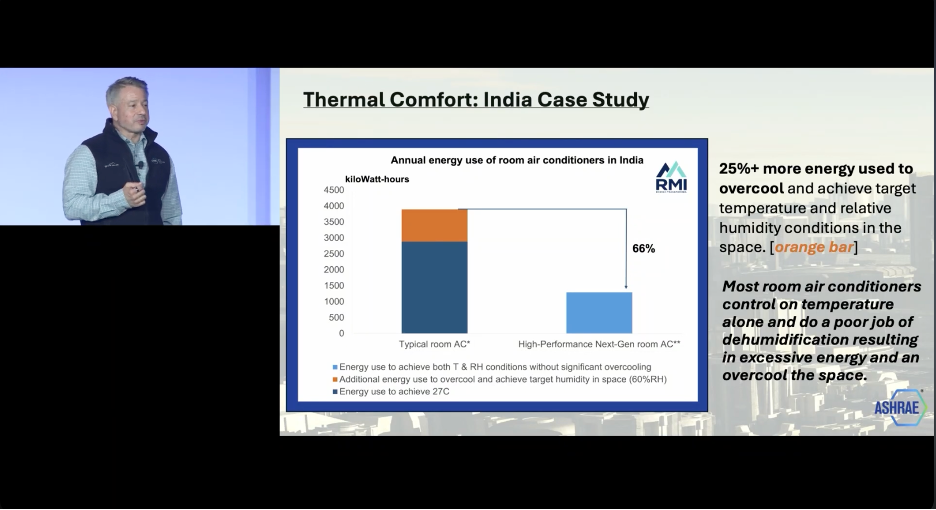
Bill McQuade, President of ASHRAE, featured findings from our real-world testing in his inaugural address. He underscored our message:
“Overcooling to manage humidity drives excessive energy use — even in the most efficient units. Managing humidity and temperature together is key.”
Looking Ahead: 2026 and Beyond
We end 2025 with energy and momentum — and, importantly, a deeper understanding of the ecosystem gaps, the enablers needed to address them, and how to work more effectively with these stakeholders.
Our vision for 2030 remains clear: 5 percent of the global room AC market powered by super-efficient, climate-friendly room AC technologies.
In 2026, we aim to strengthen three pillars:
- Capability building of the manufacturing ecosystem with technical know-how and sharing evidence on real-world performance impact
- Scaled pilots across diverse climates and customer types to create additional proof points and build buyer confidence
- Market activation through finance, demand aggregation, and consumer awareness that builds on the early exploration efforts to support the uptake of super-efficient ACs
Our 2025 progress is thanks to the support of our many partners across the globe, we’re looking forward to a promising and impactful 2026.