From Coal to Carbon Neutral: Catawba College Paves the Way
How a small liberal arts college in North Carolina is investing in clean energy, offering a blueprint for other institutions to follow.
The most inspiring colleges aren’t just places of learning. They live their values on campus every day. Catawba College — a private liberal arts institution in Salisbury, NC — has done just that. Established in 1851, it was the first college in the Southeast, and one of only 13 in the nation, to become certified carbon neutral. This is a major achievement for any college campus, particularly one with only around 1,200 students.
And the college is building on its commitment to clean energy and environmental education simultaneously. Catawba’s current capital projects include the construction of new, high-performance buildings, along with the modernization of aging infrastructure. The work is delivering multiple benefits — all while prioritizing cost efficiency. While addressing deferred maintenance, the upgrades will also enhance comfort for students and staff, as well as optimize energy use.
As a small institution, Catawba’s plans for a more resilient future offer a blueprint for other colleges and universities. As facilities age, many are facing similar priorities to maintain and enhance their campuses cost-effectively, while minimizing emissions and lowering exposure to rising energy costs.
RMI collaboration
Catawba has long been a sustainability innovator in higher education, supported by nearly two decades of partnership with RMI. Marty Pickett, RMI’s general counsel and trustee, was introduced to Catawba by our donor Fred Stanback, and Marty has served on the advisory board, alongside Stanback, of Catawba’s Center for the Environment since 2009, a “coming home” of sorts since she grew up less than an hour’s drive away. RMI cofounder Amory Lovins has spoken numerous times over the years at Catawba, on topics such as “Transforming the Energy System for Security and Prosperity” and “Profitable Solutions to Climate, Oil and Proliferation.” and Lovins, Pickett, and various other RMI staff have taught at Catawba’s National Environmental Summit for High School Students for many years, emphasizing RMI’s systems thinking.
Drawing on Amory Lovins’ principles of integrative design and RMI’s expertise, the college has sought advice on various projects including a retrofit of the Center for the Environment’s building, which was a high performance building even before the Green Building Council was established, and collaborated with RMI on advancing the campus’s energy plan that includes investing in its new district energy system.
“Catawba College leadership’s bold vision and actions on sustainability, clean energy, and regenerative design make it an inspiring model for the community, higher education, and most importantly for its students and faculty” noted Marty Pickett.
Catawba’s resilient infrastructure
Since 1996, Catawba’s Center for the Environment has served as a living laboratory for hands-on education, an approach now woven throughout campus life. “We want to be leaders in the field of environmental sustainability and regenerative design,” said Lee Ball, vice president of sustainability and executive director of the Center for the Environment at Catawba. Ball has been at the forefront of initiatives that prepare students to become the next generation of sustainability leaders.
We want to be leaders in the field of environmental sustainability and regenerative design.
That vision first took tangible form in 2001, when students helped design the center’s original 21,000-square-foot building. Their efforts reduced projected energy consumption by 30–40 percent over the building’s lifetime compared to standard construction. They also recycled more than 86 percent of construction waste, a material circularity practice then well ahead of its time. Reusing or recycling construction waste is essential to cut a project’s resource consumption and overall embodied carbon. While the center was later renovated in 2023, the tradition of student leadership continues, with more than 60 students helping to design the college’s innovative Smokestack and new residence hall projects.
Catawba was also an early leader in its use of renewable energy in higher education. These systems not only reduce emissions but also deliver strong financial returns and provide a more reliable and resilient energy source for the future. In the 1980s, the college installed solar thermal systems, a way to heat water by warming it with the sun. That was followed in 2015 by approximately 837 kW of solar panels. At the time, this installation produced more renewable energy than all other North Carolina higher education institutions combined, while delivering savings forecast to total $5 million over 20 years. In 2024, the college added another 55 kW of solar, with further expansion planned.
A complementary focus of Catawba’s renewable energy strategy is its use of geoexchange systems, which use the Earth’s consistent temperatures below ground to deliver energy-efficient heating and cooling year-round. The college installed its first “open-loop” system in the 1990s using water from local aquifers.
Now a new, more ambitious geoexchange system is taking center stage in the school’s District Energy and Modernization (DEM) project. In 2024, the college drilled 39 wells for a closed-loop geoexchange system that circulates water through a contained pipe network. This updated design is more efficient, more durable, and easier to upgrade than the original open-loop system. It is part of a four-phase installation that will eventually provide heating and cooling to 26 campus buildings. As part of this buildout, wells are being placed beneath the soccer field to centralize maintenance and maximize use of space, says David Karlsgodt, vice president for infrastructure, energy, and sustainability at Washington, D.C.-based Brailsford & Dunlavey. Once complete, “the system will cut at least 265 MMBtu of gas and 145,724 kWh of purchased electrical energy [per year], reducing carbon emissions by 51 metric tons.”


Modernizing for a more resilient future
The DEM project spans nearly every corner of campus and conveniently coincides with significant upgrades to aging equipment and facilities. “Catawba wants to upgrade to operational carbon neutrality in a smart way,” explained Jason Volz, project manager and partner at CMTA, an engineering firm that specializes in sustainable and high-performance building systems. He noted that the college is aligning deferred maintenance needs with a shift toward district energy to move away from fossil fuels, while improving student, staff, and faculty comfort, cutting carbon emissions, and reducing long-term costs.
One example is the Abernethy Physical Education complex, a 90,000-square-foot facility with a pool but limited air conditioning, leaving spaces such as the main lobby uncomfortable in North Carolina’s heat and humidity. Many of Catawba’s older buildings face similar issues, from outdated HVAC systems to insufficient wall insulation and vapor barriers. Over the years, efforts to improve comfort in some older buildings have been scattershot, but achieving decarbonization targets now requires a more holistic approach.
“If I address the HVAC but I don’t address the envelope, I’m just heating and cooling the outside,” Volz explained. Still, there are some advantages hidden in this legacy infrastructure. Several older buildings are already connected into the campus’s original geoexchange system, which means they can connect to the new system at minimal expense — a welcome cost savings brought about by an innovative investment over 20 years ago that continues to pay off today.
Decarbonizing old and new
One of the clearest symbols of Catawba’s decarbonization efforts is its Smokestack building. A coal-fired power plant that operated from the 1950s to 1990s, the structure stood as a reminder of past dependence on dirtier, more harmful fuel sources. Today, the building is being transformed into a 10,000-square-foot student life hub and living laboratory that will be connected to the DEM and use photovoltaic panels, reaching net-zero (or better) once complete.
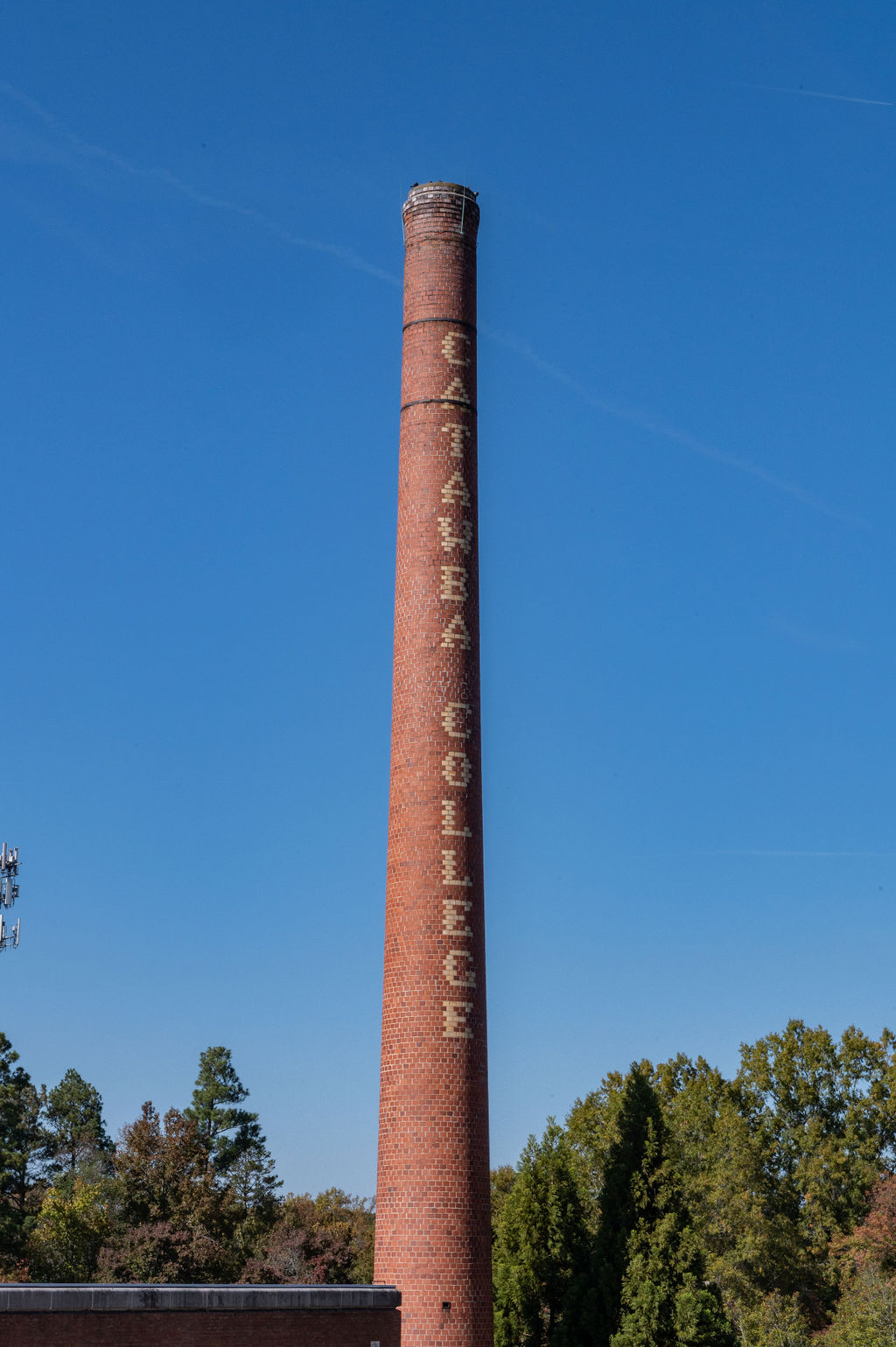
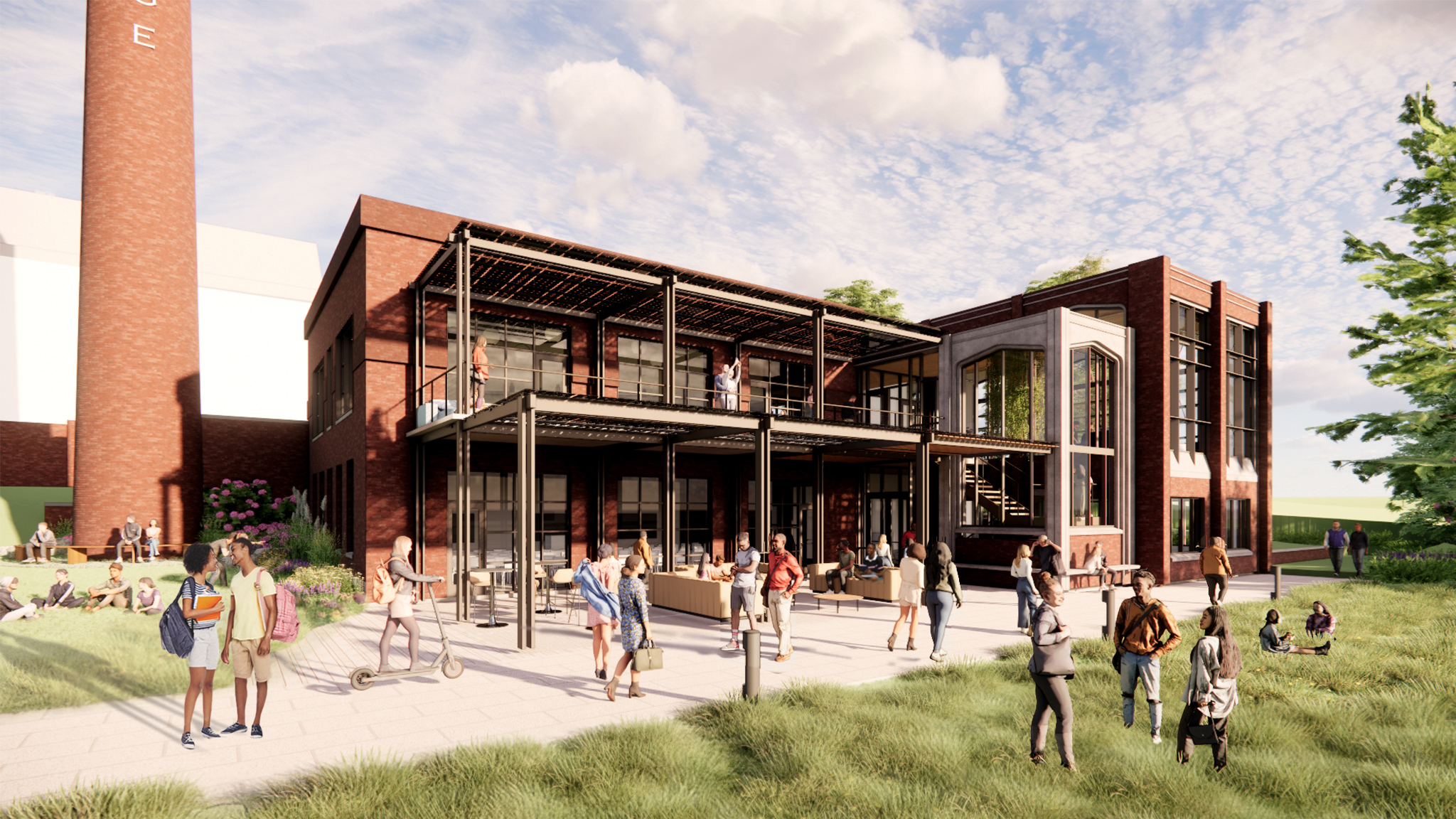
The Smokestack’s new design will emphasize harmony with the local environment, ensuring it will look as good as it performs. Additionally, the Smokestack is slated to be certified LEED Platinum and certified by the Living Building Challenge Core Imperative, which assesses not only energy and carbon performance, but also water use, ecology, aesthetics, material health, education, and more.
These decarbonization efforts also extend to new construction. In April 2025, the college broke ground on a three-story, 130-bed residence hall featuring a great room with a kitchenette, a community lounge, study rooms, laundry facilities, and other student amenities. The residence hall is designed to meet Passive House US certification — the most rigorous US building standard for energy efficiency, thermal comfort, moisture, and ventilation — and will tie into the DEM system.
According to Catawba, the residence hall will reduce energy use by 55 percent, heating loads by 44 percent, and cooling loads by 75 percent compared to typical North Carolina construction. Once open, the building will free up older dorms to undergo additional energy-saving renovations, creating a ripple effect of energy savings and comfort improvements. These investments help to address the growing impacts of climate change, while also improving student retention and laying the groundwork for future enrollment growth.

Learn, invest, save, repeat
Innovation at this scale comes at a cost, but the decision to move forward with the projects went beyond financial return. “When presenting this to the board, it was not just financial [return on investment],” said Ball. “It was recruitment, retention, our sustainability and carbon goals, and a big part of our deferred maintenance plan. We’re tackling carbon and deferred maintenance simultaneously.”
Catawba College President David Nelson echoed this perspective, framing it within a broader lens of stewardship. “I look at this from an angle of what I would call a ‘good economy’ as opposed to a ‘goods economy,’” he noted. “The word ‘economy’ is misconstrued. We use it to talk about money and finances, but economy is really the good stewardship of all that’s been entrusted to us — and that includes clean air, land, and water, and taking care of the people and the creatures that live on the land. My twist with a couple of our board members was to say, “It makes good financial sense, but it makes even better economic sense.’”
Of course, financing this initiative remains a practical reality, and the DEM represents a major commitment for the college. While Catawba has been fortunate to draw from endowments and generous donors, President Nelson emphasized that it’s also a testament to the college’s values and legacy that the board and leadership were willing to take on that challenge. Yet, a preliminary net present value (NPV) cost analysis suggests the risk is minimal. When compared with business-as-usual practices, NPV projections show the DEM will save the college approximately $10 million between 2025 and 2054 when considering costs associated with energy, operations and maintenance, and other factors.
Ball reinforced this point, saying that Catawba’s decades of successful sustainability experience make it feel less risky than it would on some other college campuses. He also sees this as an opportunity for Catawba to serve as a model. “When we have the ability to do this, maybe another campus could do some version of it,” he said.
“They can come here and learn, talk to our campus engineers or partners to help with design, or meet the people who are actually running the systems. We can explain to them in real time,” Ball said. “Here’s what it takes, these are the pain points, and this is what we like about it.”
Though unique for a small Southeastern college, Catawba’s solar power, geoexchange heating and cooling system, and other sustainability initiatives are an investment in its future — and a blueprint for other institutions charting their own decarbonization journeys.