
Five Policies to Lower Heating Bills and Accelerate Heat Pump Adoption in Illinois
Targeted incentives, zero-interest financing, smart rate design, and building code updates can reduce household energy costs while advancing Illinois’ clean energy goals.
Introduction
Illinois has recently made significant progress toward its clean energy and affordability goals. Following the Clean and Equitable Jobs Act’s (CEJA) commitment to a 100 percent clean energy economy, the Illinois Commerce Commission (ICC) launched the Future of Gas proceeding to evaluate how state decarbonization will impact the natural gas system. This includes identifying the least-cost pathway to reduce building emissions, including strategic electrification and limiting escalating gas infrastructure investments. This article addresses those questions by examining the cost of electrification at the household level and identifying solutions to improve affordability.
Illinois must accelerate heat pump adoption to meet its climate goals
The opportunity to decarbonize Illinois’ buildings is substantial. As shown in exhibit 1, the state has nearly 3.7 million single-family homes, with 86% heated by natural gas and another 11% using propane or electric resistance heat.
Air-source heat pumps (ASHPs) and heat pump water heaters (HPWHs) have great potential to cut carbon pollution from these homes. Space and water heating account for more than 95% of direct residential emissions in Illinois, and heat pumps installed today can cut lifetime operational emissions by over 50% compared to a gas furnace in Illinois. Electrifying all single-family households would reduce statewide emissions by approximately 6.5% by 2050 when paired with the statutorily mandated 100% clean energy under the Clean and Equitable Jobs Act.
Exhibit 1
Heat pump affordability in Illinois today
Given rising energy bills, it is critical that heat pump upgrades improve energy affordability. This is especially true for low-income households who spend 13% of their income on energy in Illinois. To ensure this transition remains affordable, RMI conducted a detailed techno-economic analysis using the Green Upgrade Calculator to determine heat pump affordability across the state today and the most effective strategies for enhancing it.
Key findings include:
-
Heat pumps can reduce energy bills for most Illinois single-family households when including both all-electric and hybrid systems.
-
Households heated with propane and electric resistance see the largest annual bill savings ($930 and $1,110, respectively) with all-electric heat pumps. For gas-heated homes, the bill savings vary by heat pump design and utility territory.
-
While heat pumps can lower energy bills, they typically have an up-front cost premium relative to traditional system replacements, underscoring the need for additional incentives and accessible financing.
Five policy recommendations for Illinois lawmakers and regulators to enhance heat pump affordability and support upgrades
These strategic policies, increasingly adopted by states and cities nationwide, can help Illinois residents access heat pumps that reduce their energy bills.
-
Increase heat pump and weatherization incentives and phase out gas equipment incentives.
-
Provide 0% financing to make heat pumps affordable from day one.
-
Establish effective rate design and proactive customer enrollment strategies to maximize energy bill savings.
-
Implement an AC-to-heat pump policy to scale deployment while preserving customer choice.
-
Adopt electric-friendly standards for new construction when electrification is most affordable.
1. Heat Pump Affordability in Illinois Today
Assessing heat pump affordability must reflect both up-front installation costs and ongoing operating expenses. While affordability may be defined differently across customers, a common goal is for heat pumps to have minimal up-front cost premiums compared to business-as-usual systems and to deliver energy bill savings that offset any premiums quickly — often within a few years.
Heat pump operational costs
Like many home appliances, ASHPs come in different designs and sizes. Some systems are sized to meet a home’s full heating load — meaning they provide all heating needs throughout the year — while others are sized to meet only a portion of the load and rely on a backup system during the coldest days. The ASHP design with the largest energy bill savings depends largely on the home’s existing fuel source, utility provider, and enrolled electric rate. When these characteristics are taken into account, ASHPs can lower energy bills for nearly all Illinois households.
For single-family households in Illinois with electric resistance or propane furnaces, an all-electric full-load ASHP reduces energy bills the most. With this heat pump design, residents upgrading from electric resistance or propane furnaces could reduce their annual energy bills by an average of $1,110 and $930, respectively. Over the fifteen-year lifetime of the appliance, that translates into bill savings of more than $16,600 for households switching from electric resistance and more than $13,900 for those switching from propane.
These substantial savings make full-load heat pumps one of the most effective tools to lower energy bills for the 430,000 single-family households using these fuels in Illinois.
Exhibit 2
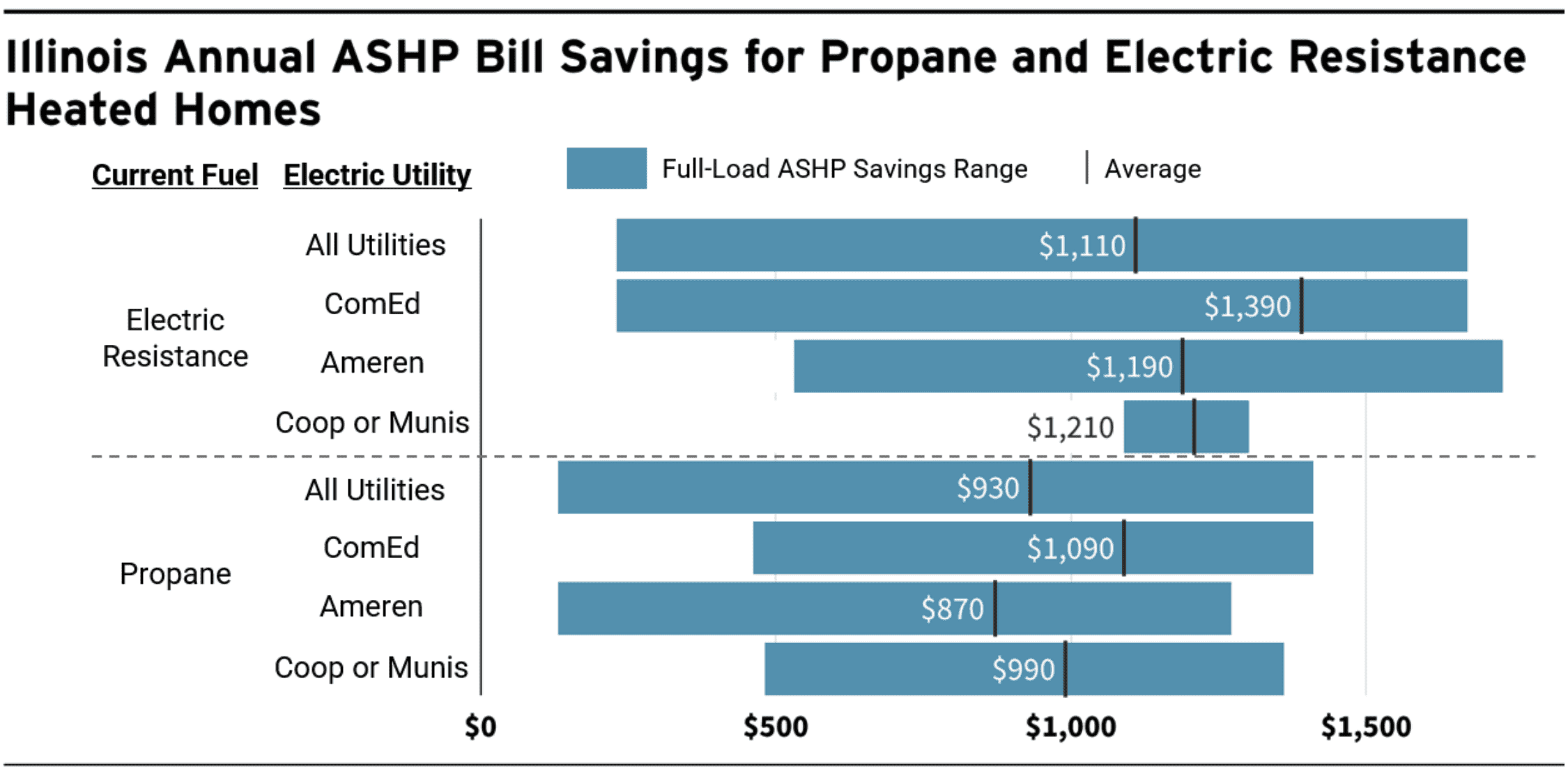
Residents upgrading from electric resistance or propane furnaces to air-source heat pumps could reduce their annual energy bills by an average of $1,110 and $930, respectively
For homes with gas furnaces, the ASHP design with the lowest energy bills depends on the electric and gas utility provider. For non-Nicor Gas customers, an all-electric full-load ASHP provides energy bill savings greater than or very similar to the energy bill savings from installing a hybrid ASHP. The largest savings are for Peoples Gas and Commonwealth Edison (ComEd) electric customers, averaging $390 per year when installing an all-electric full-load ASHP instead of a gas furnace. These customers face the highest gas prices in the state and, switching to an all-electric heat pump, can move to a non-gas heating rate with lower monthly gas fixed charges, and to ComEd’s electric heating rate, which offers lower electricity prices.
For Nicor Gas customers, a hybrid ASHP sized to the cooling load and paired with the existing furnace for supplemental heat (i.e., part-load ASHP) reduces energy bills the most, but marginally, with average annual savings of $20. The hybrid heat pump bill savings for these customers would be greater if ComEd and Nicor adopted appropriate rate design improvements for hybrid heat pump users (see Recommendation #3).
Exhibit 3
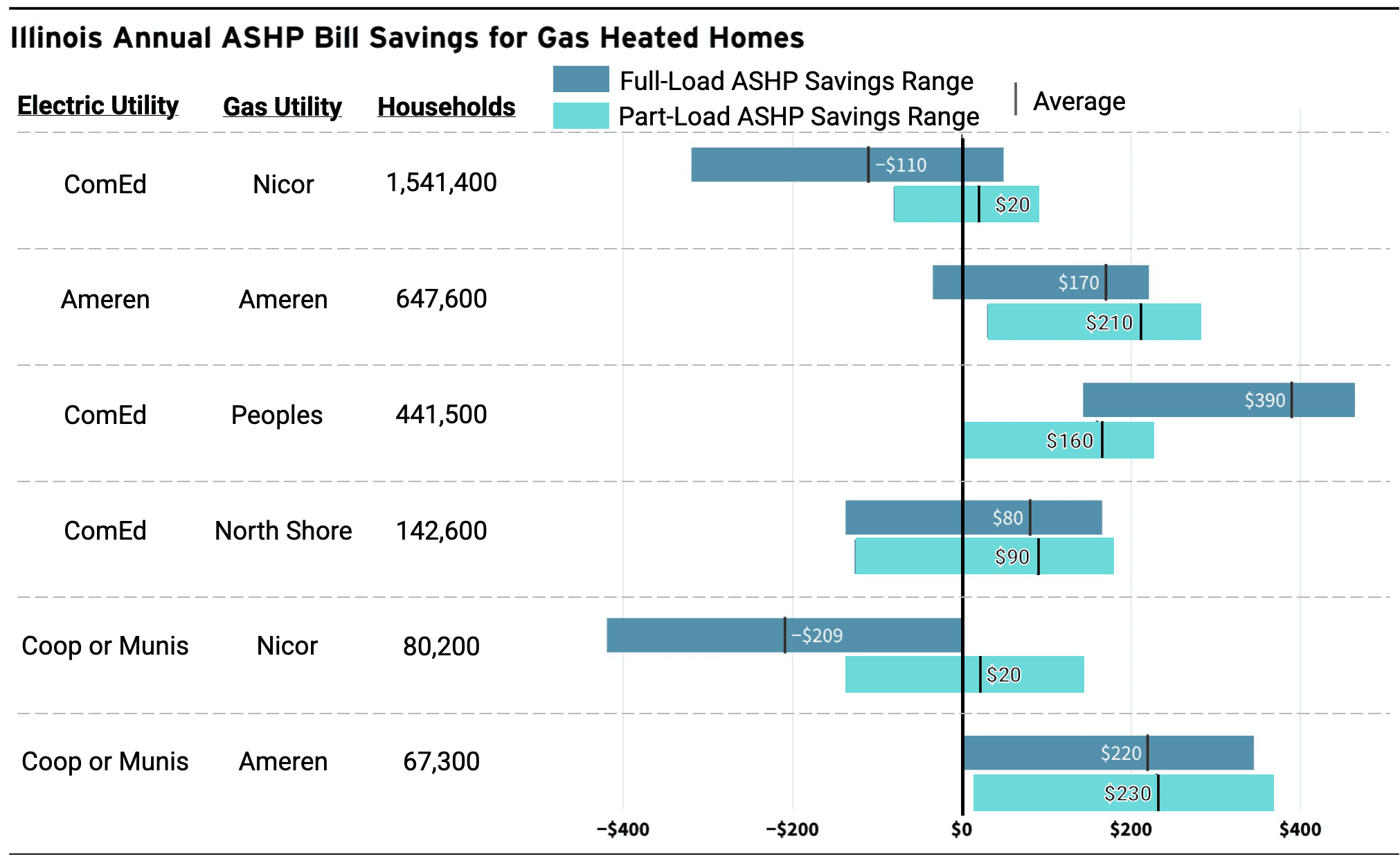
When heat pumps are appropriately designed, ASHPs can reduce energy bills for most Illinois households.
Energy bill savings for hybrid part-load ASHPs depend largely on the system’s “switchover temperature,” the outdoor temperature at which the system switches from the heat pump to the furnace. Savings are maximized by running the ASHP during moderate temperatures, when it is most efficient, and switching to the gas furnace during the coldest hours. Because households can adjust this switchover temperature through their thermostat, they retain flexibility to optimize bill savings as electric and gas rates change over time.
In this analysis, we modeled a switchover of 35°F for Nicor and North Shore Gas customers and 25°F for all other customers to ensure bill savings. While the lower switchover temperature was low enough for the hybrid ASHP to meet most of their heating load while still achieving bill saving, the higher switchover temperature to maintain bill savings did not result in the hybrid heat pump serving most of the heating load.
To enable Nicor and North Shore gas customers to both lower their energy bills and meet the majority of their heating load with a hybrid heat pump, changes to rate design are needed: If hybrid heat pump customers whose systems provide most of their heating were allowed to enroll in ComEd’s electric heating rate (which is not allowed today), households could adopt lower switchover temperatures while maintaining bill savings (see Recommendation #3).
After space heating, water heating is the next largest source of direct emissions in residential buildings, making it a critical component of building decarbonization. Heat pump water heaters (HPWHs) can also deliver meaningful bill savings, as they are three to four times more efficient than conventional units. As with ASHPs, savings vary by existing fuel type: households switching from electric resistance water heaters save an average of about $270 per year, while those switching from propane save roughly $110. Bill impacts are more modest for gas homes, averaging about $10 annually, with nearly all households seeing less than a $50 change.
Heat pump up-front costs
ASHPs can carry higher up-front costs than traditional heating or cooling system replacements today, primarily depending on system design and the equipment being replaced.
-
Full-load cold climate heat pumps replace both a furnace or boiler and an air conditioner (AC). They have the highest up-front costs because they must be sized to meet a home’s full heating demand and they come with higher-cost equipment to deliver all heating and cooling in a single system. While HVAC up-front cost data in Illinois is limited, RMI’s Green Upgrade Calculator estimates these systems may cost $2,000 to $8,000 more than a new combined furnace and AC. For homes currently heated with electric resistance and propane — where heat pump bill savings are substantial — this up-front cost premium can be recovered in just a few years.
-
Hybrid part-load heat pumps, typically sized to replace an AC while retaining an existing furnace for supplemental heat, offer a lower-cost entry point than full-load systems. However, they still have a cost premium relative to AC-only replacements — typically around $1,000 to $2,000 — due to small additional equipment components and supply chain markups.
HPWHs can also have higher up-front costs than their alternatives — typically around $2,500 more than gas or propane water heater replacements and $1,000 more than electric resistance models before incentives, according to RMI’s Green Upgrade Calculator. While their much higher efficiency can lead to energy bill savings to pay back these premiums, further incentives are needed to shorten the payback.
2. Five Policies to Enhance Heat Pump Affordability in Illinois
The following five policies outline practical, near-term actions to improve heat pump affordability and accelerate adoption across Illinois. These policies are mutually reinforcing — when implemented together, they deliver significantly greater affordability and adoption impacts than any single policy alone.
Policy #1. Increase heat pump and weatherization incentives and phase out those for gas equipment
High up-front costs remain one of the most significant barriers to heat pump adoption in Illinois, particularly for older homes and low-income homeowners. While Illinois utilities have expanded energy efficiency and electrification programs under the Future Energy Jobs Act (FEJA), Climate and Equitable Jobs Act (CEJA), and Clean and Reliable Grid Affordability Act (CRGAA), current incentives — typically $500 to $2,000 for an ASHP and up to $1,150 for a HPWH — are insufficient to overcome electrification cost premiums.
To improve affordability, heat pump incentives should be increased and better aligned with real-world installation costs, and weatherization incentives should be expanded to improve affordability in older housing stock.
All-electric full-load ASHPs
Full-load heat pumps that replace both an AC and a furnace or boiler face the highest up-front costs. An $8,000 incentive would remove most of the cost premium relative to replacing a single AC or furnace — most common decision point for homeowners — and would likely make a heat pump less expensive than installing a new AC and furnace. These incentives should be available to all customers, with targeted outreach for low-income propane- and electric resistance-heated homes, where annual energy bill savings are significant ($930 and $1,110, respectively), and will have the largest affordability benefits today.
Hybrid part-load ASHPs
Part-load heat pumps (sized to replace an AC while retaining an existing furnace) offer a lower-cost entry point than full-load systems but still carry a premium over AC-only replacements. A $2,000 incentive would likely eliminate this premium, enabling an AC-to-heat pump policy where heat pumps are the least-cost choice at the point of AC failure (see recommendation #4). To ensure meaningful energy and carbon benefits, programs could require a maximum switchover temperature, so the heat pump provides the majority of annual heating.
Heat Pump Water Heaters
Despite delivering a three- to four-fold efficiency improvement over conventional water heaters, higher up-front costs limit HPWH adoption. A $2,000 incentive would eliminate the full cost premium relative to electric resistance units and cover most of the premium compared to gas or propane equipment, significantly expanding deployment. Incentives could also prioritize demand-response-enabled models to capture additional peak demand savings.
Weatherization
Weatherization can play a critical role in improving heat pump affordability — particularly in older and low-income homes — by enabling smaller and less expensive heat pump installations and lowering ongoing energy bills. This is especially relevant in Illinois, where nearly two-thirds of homes were built before 1980 and often lack sufficient insulation or air sealing.
Weatherization supports affordability in two primary ways:
-
Reducing installation costs: Air sealing and insulation reduce peak heating demand, allowing smaller heat pumps to be installed. This both reduces up-front equipment costs and enables higher heat pump adoption before additional grid capacity is needed, helping keep electricity rates lower for all customers. For example, RMI’s Green Upgrade Calculator estimates that downsizing an ASHP from four tons to three tons due to weatherization can reduce ASHP up-front costs by around $1,100.
-
Lowering energy bills: RMI analysis shows that reducing air leakage by a standard 25% can lower annual energy bills for all-electric ASHP homes by an average of $110. For low-income households, deeper weatherization costs are covered up to $8,000 by the Weatherization Assistance Program (WAP). Pairing air sealing with attic (R-40) and wall (R-13) insulation can reduce annual bills by an average of $400. These savings can enable many Nicor gas-heated homes — where hybrid part-load systems are currently most affordable — to also achieve bill savings from all-electric full-load ASHP systems.
Despite these benefits, existing weatherization programs reach only a small share of eligible households. The WAP currently serves only about 3,000 low-income homes per year, while utility insulation and air-sealing rebates are similarly limited in scale. To better scale weatherization, Illinois could inject the WAP program with state funds or expand utility efficiency programs by requiring higher energy savings targets and raising the program spending cap. Better coordination between weatherization and heat pump programs would also ensure households can capture the full cost and performance benefits of both upgrades.
Gas equipment
Roughly $5 million annually is spent on customer-funded residential gas equipment incentives by Illinois’ four largest gas utilities. With changing market conditions for appliance purchases and competing priorities with heat pumps, the value of gas incentive measures is shrinking. In light of these trends, a redesign of gas utility efficiency customer programs is timely.
Customers are increasingly purchasing higher efficiency furnaces as their default choice with and without incentives, as evidenced by program evaluations in Maine and Maryland. Because of this, the incremental value of these programs is diminishing. Electric heat pumps for space and water heating are also emerging as alternatives to gas equipment that align with state climate goals and lower energy bills. Continuing to subsidize gas heating risks creating competing incentives and weakening heating electrification programs.
Redirecting these funds to weatherization would deliver more durable savings — often for 20 to 100 years — and provide energy system benefits whether households continue heating with gas or transition to electric heating.
Exhibit 4
Increasing heat pump incentives and redirecting those for gas to weatherization better aligns efficiency programs with state goals
Illinois has an opportunity to redirect its efficiency funding toward electrification and weatherization. Recognizing the climate and affordability benefits of heat pumps, other states are already moving in this direction. For example, Duke Energy recently received approval to nearly double its ratepayer-funded heat pump incentives, and Colorado created refundable heat pump tax credits through a state budget appropriation.
Policy #2. Provide 0% financing to make heat pumps affordable from day one
Up-front costs remain one of the primary barriers to heat pump adoption, even when lifetime energy bill savings exceed the initial cost premium. Zero-interest financing can address this barrier by eliminating up-front expenses and enabling households to still save on their monthly energy bill.
For homes currently heated with electric resistance or propane systems, zero-interest financing can make it possible to install a heat pump with no up-front payment while lowering total monthly bills (i.e., energy bills and loan payments). In many cases, the combined energy bill and loan payment for a heat pump is lower than that of a business-as-usual replacement system. This approach effectively converts long-term cost advantages into near-term affordability.
RMI’s analysis finds that with zero-interest financing for ASHPs, the average annual combined equipment and energy costs for a full-load ASHP in Illinois would be approximately $2,940 — about $800 less than the combined costs of installing a new propane or electric resistance furnace and AC, financed at market rates. These combined ASHP costs are also comparable to replacing a furnace alone, while avoiding the need for a future AC replacement, which typically costs around $8,000.
Exhibit 5
An ASHP financed at 0% would lower annual bills by $800 compared to a market-rate financed propane or electric resistance furnace and air conditioner.
Illinois does not currently offer a statewide low-interest financing program for residential energy upgrades. While some utilities, including ComEd and Ameren, participate in the Illinois Energy Efficiency Loan Program, these loans are offered at market rates (currently around 7.7 percent), which limits their effectiveness for many households. Although CEJA authorized an Energy Efficiency Upgrade Program — similar to Ameren Missouri’s tariffed on-bill financing model — this program has not yet been implemented.
To address this gap, Illinois could establish a statewide zero-interest financing program for heat pumps and weatherization. Other states offer proven models: Massachusetts’ HEAT Loan uses green bank capital to buy down interest rates, while NYSERDA has deployed their On-Bill Repayment program. Various approaches can be effective, but success depends on delivering financing that is low-interest, easy to access, and designed for broad household eligibility.
Policy #3. Establish effective rate design and proactive customer enrollment strategies to maximize energy bill saving
Rate design is a critical lever for affordable building decarbonization. To ensure heat pumps deliver real bill savings, electric and gas rates must align with the cost of service and state affordability and emissions goals, supported by effective customer enrollment.
Electric rate design
Illinois’ two electric investor-owned utilities (IOUs) have already taken meaningful steps to align rates with seasonal grid costs and different customer types. Ameren, for example, incorporates seasonal pricing into its standard electric rate, allowing all customers to benefit from lower winter electricity prices that more accurately align with the cost of service. ComEd also offers an electric heating rate tailored for homes using electricity (including heat pumps) for space heating, recognizing that the cost to serve electric customers is typically lower in colder months when electric heating use is highest.
Rate design only supports heat pump adoption if customers are enrolled in the rates that best match their equipment and usage. When utilities offer multiple residential rates and one is significantly more favorable for electric heating, such as ComEd’s electric heating rate, proactive enrollment becomes essential. To ensure customers benefit, Illinois should pursue two complementary strategies:
-
Customer rate optimization and enrollment
Utilities can support effective enrollment by providing rate optimization tools for installers and customers or by automatically enrolling customers in electric heating rates when a heat pump incentive is issued. Massachusetts’ IOUs, for example, auto-enroll customers into their heat pump rate class when their heat pump incentive is issued. -
Ensure part-load ASHPs qualify for electric heating rates
If part-load heat pumps have a switchover temperature low enough to provide most of a home’s heating needs, these users should be eligible for electric heating rates. As an initial step, the ICC could work with ComEd to allow customers with part-load ASHPs to access its electric heating rate, which is not currently available to them, with confirmation of sufficiently low switchover temperature settings.Access to this rate is important for energy affordability. RMI analysis finds that allowing hybrid part-load heat pump users with a 25°F switchover temperature (low enough to provide most of the homes heating) to enroll in ComEd’s electric heating rate would increase average energy bill savings by roughly $140 to $150 per year for Nicor and North Shore gas customers, and even more for Peoples gas customers. A lower switchover temperature would also increase HVAC carbon savings with a hybrid heat pump. Carbon savings would increase from 24% reduction with a 35°F switchover to 52% with a 25°F switchover, when accounting for Illinois’ commitment to 100% clean energy.
Exhibit 6
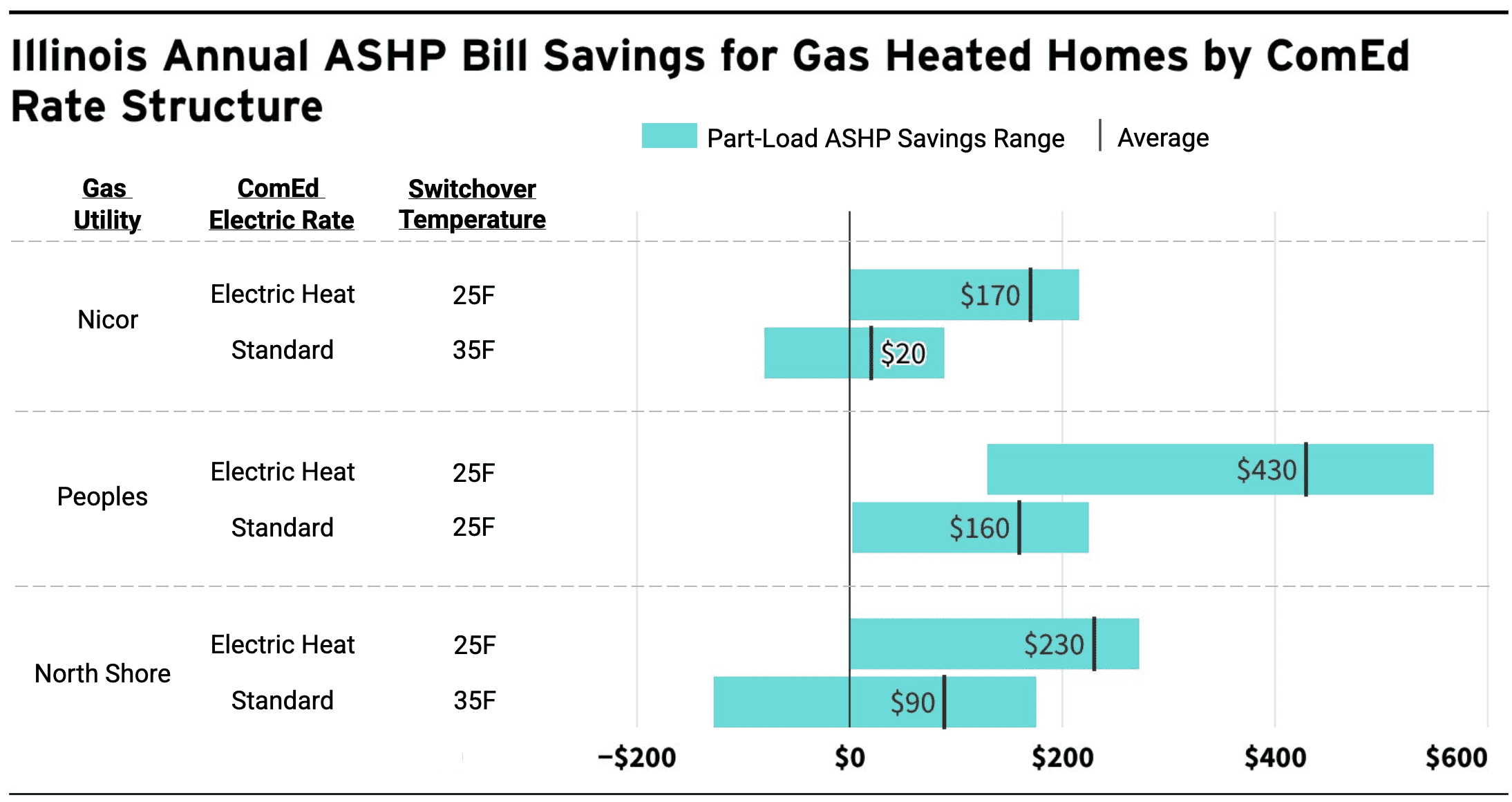
Allowing ComEd hybrid part-load heat pump customers whose systems provide the majority of space heating (by setting a lower switchover temperature) to enroll in the electric heating rate would increase both energy bill and carbon savings.
Gas rate design
Gas rate design also plays a significant role in building decarbonization outcomes. Illinois utilities have the tenth-highest average residential gas fixed charges in the country. These high fixed gas charges result in lower volumetric charges (i.e., cost per gas used), limiting customers’ ability to lower gas bills through efficiency improvements or partial electrification.
To better align gas costs with usage, Illinois should reform gas rate design to reduce fixed charges, ensuring that customers who reduce gas consumption can realize meaningful savings. These changes will also support affordability and emissions reduction goals for customers who invest in energy efficiency improvements like heat pumps.
In addition, Nicor and Ameren could include separate gas heating and non-gas heating rates to better reflect their cost of service and better enable ASHP bill savings. For example, Peoples and North Shore offer a non-gas heating rate for customers not using gas equipment as their primary heating source (including customers with hybrid heat pumps where the heat pump serves most of the heating load). These rates include roughly $130 and $90 lower gas fixed charges per year, respectively, than their gas-heating rate, reducing energy bills for ASHP customers with limited remaining gas use.
Lastly, Illinois could initiate a broader gas and electric rate investigation to identify where current rate structures stray from cost causation principles or hinder electrification, and to align with long-term decarbonization goals.
Policy #4. Implement an AC-to-heat pump policy to scale deployment while preserving customer choice
Because a central ASHP is essentially a two-way central AC — providing both heating and cooling through the same ducts and outdoor unit as a central AC — replacing a failing central AC represents one of the easiest and lowest-cost opportunities to scale ASHP adoption. The most affordable ASHP design varies by existing heating fuel and utility provider, so this natural replacement moment also allows homeowners to size an ASHP to cooling (part-load) or heating (full-load), preserving customer choice.
An AC-to-heat pump policy leverages this opportunity by encouraging households to swap a one-way central cooling system (an AC) for a two-way heating and cooling system (an ASHP) at the point of AC replacement. This approach brings ASHP benefits to Illinois households with minimal additional costs or disruption, while retaining the freedom to choose an ASHP and the design that best aligns with their priorities. This strategy also applies to the vast majority of Illinois homes, as nearly 90% of single-family houses in the state already have central ACs and can scale ASHP deployment quickly.
A well-designed AC-to-heat pump policy typically includes the following:
-
Updates to the residential energy code that encourage — not mandate — the installation of a two-way central AC that provides heating and cooling (an ASHP) when replacing a one-way central AC. Alternatively, residents can install a traditional AC system with additional energy conservation measures, like air sealing or insulation to lower energy use and bills.
-
Coordination with ASHP incentives to remove or reduce the marginal up-front cost premium of ASHPs relative to ACs (see Policy #1).
-
Flexibility in design — allowing homeowners to choose between ASHPs sized similarly to their AC while keeping their furnace or sized to the full heating load, depending on household priorities.
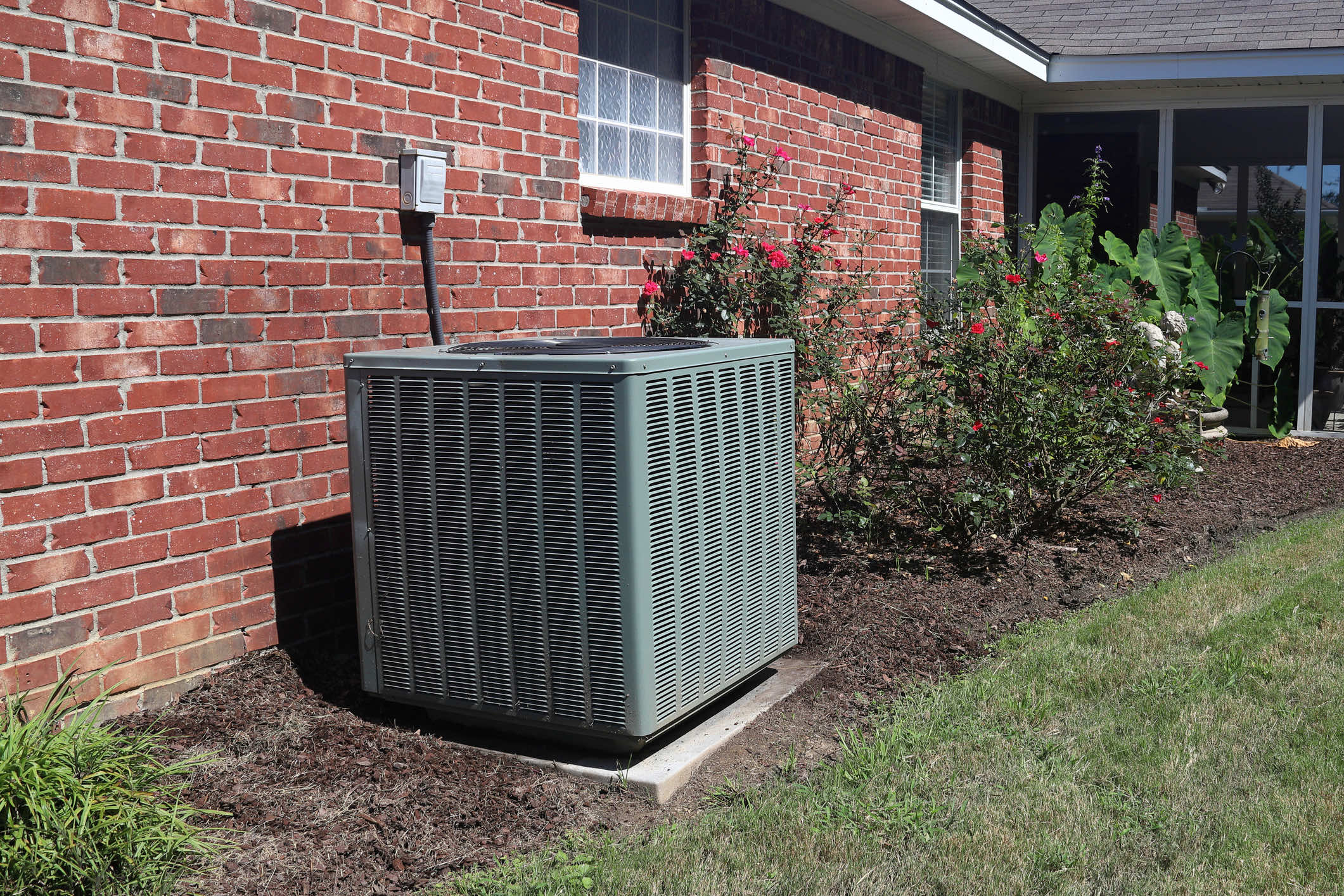
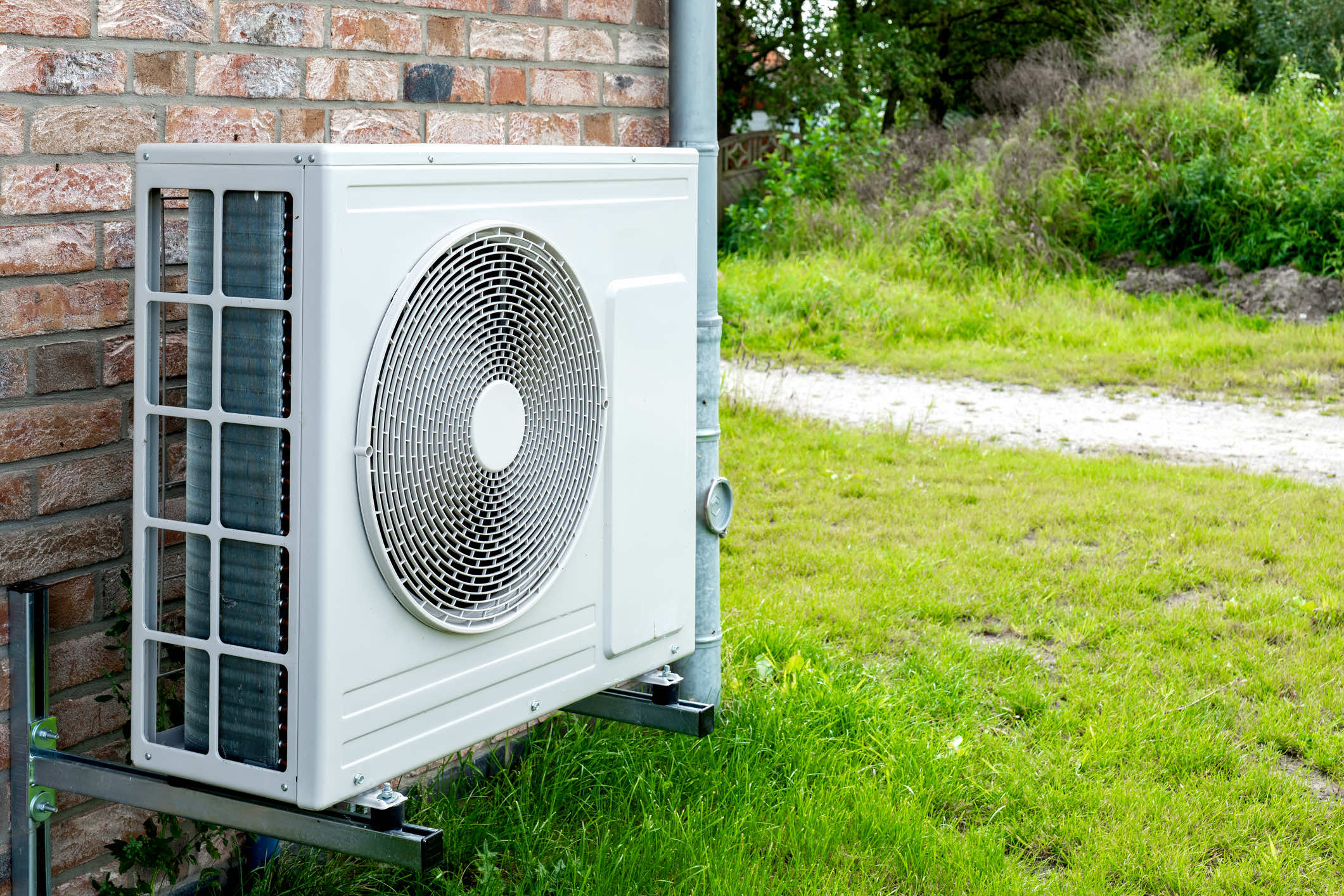
Visually and pragmatically, an air conditioner (left) is very similar to a heat pump (right)
Policy #5. Adopt electric-friendly standards for new construction when electrification is most affordable
The most affordable time to electrify a home or building is during construction. Installing electric infrastructure up-front is far less expensive than retrofitting later, and all-electric buildings avoid the up-front cost of gas service entirely. Options like 1) electric-ready construction, 2) fuel-debiasing energy codes, and 3) all-electric construction are proven tools to accelerate electrification in new homes and buildings.
Electric-ready construction
Electric-ready construction ensures new buildings have sufficient electrical capacity and wiring or raceways to support all-electric appliances, saving roughly $1,200 per Illinois home compared to post-construction upgrades. These standards also enhance consumer choice, allowing owners to install either electric or combustion equipment at replacement without costly retrofits. Provisions like these are already included in the Chicago Energy Transformation Code and the Illinois Stretch Energy Code, but are not yet included in the Illinois Base Energy Code which is needed to impact the vast majority of new construction.
Fuel-debiasing measures
Fuel-debiasing measures correct a structural imbalance in the 2024 IECC, which continues to favor combustion systems even though electric heat pumps are nearly three times more efficient than ENERGY STAR gas furnaces in Illinois. Homes equipped with heat pumps use less energy than comparable mixed-fuel buildings, but combustion-based homes are not required to account for their higher energy use. Fuel-debiasing provisions resolve this disparity by requiring all homes to meet the same level of overall energy performance, regardless of whether they include heat pumps.
All-electric construction
All-electric construction goes a step further by eliminating the need for gas infrastructure entirely, saving an estimated $1,800 to $10,000 per household on up-front gas service costs to connect a building to the gas system. By lowering housing costs and supporting building electrification, it aligns new home construction with Illinois’ decarbonization objectives.
These approaches reduce up-front costs, preserve customer choice, and align new construction with Illinois’ climate goals.
Meeting the moment in Illinois
The Illinois Future of Gas proceeding presents a pivotal opportunity to align state goals in building decarbonization and energy affordability. By implementing five key policies — 1) robust incentives, 2) low-cost financing, 3) smart rate design, 4) an AC-to-heat pump policy, and 5) electric-friendly new construction — the state can improve energy affordability by accelerating heat pump adoption while preserving consumer choice.
Together, these strategies offer practical, proven, and scalable pathways for policymakers to make building electrification a cost-effective, convenient, and beneficial option for households across Illinois.
Further detail on the analysis assumptions can be found here.